A practical, honest guide from Dermatology Circle — Upper East Side, NYC
If you have been thinking about a cosmetic dermatology consultation but are not sure where to start, what to ask, or what to expect, this guide is for you.
What is harder to find online is honest, practical guidance about the consultation itself — the conversation that happens before any treatment begins. This is where the most important decisions get made. Below are the questions we hear most often at Dermatology Circle, answered honestly.
Before you go
I’m not sure I actually need anything. Should I still come in?
Yes — and this is often the ideal time to come in. A consultation is not a commitment to treatment. It is a conversation. Many patients arrive with a vague sense that something has changed, but without a clear idea of what to do about it. That is exactly what the consultation is for. You may leave with a treatment plan. You may leave with the advice to wait. Both are valid outcomes.
I feel nervous about being judged for wanting cosmetic treatments. Is that normal?
Completely normal — and completely unfounded at good practice. The decision to explore cosmetic dermatology is personal and increasingly common across all ages and backgrounds. There is nothing to justify. A good physician listens without judgment and focuses entirely on understanding your goals.
I’ve seen things on social media that worried me. How do I know what to believe?
Social media is excellent for understanding what treatments look like in practice. It is poor for medical accuracy, individual suitability, and understanding risk. A trend that worked beautifully on one face may be entirely wrong for another. The best use of social media research is to arrive at your consultation with images of results you find appealing. And then let a physician tell you honestly whether and how those results are achievable for your specific anatomy.
At what age should I start cosmetic treatments?
There is no single right answer. Collagen begins breaking down in the late 20s. The most proactive patients today often begin in their 30s — not to correct visible problems, but to preserve what they have before laxity develops. That said, starting earlier is not always better. A physician-led consultation will tell you when treatment is genuinely warranted and when waiting makes more sense.
Is cosmetic dermatology only for women?
No. An increasing number of men seek cosmetic dermatology for exactly the same reasons. They want to look as well as they feel and want results that are discreet and natural. Treatments like Botox, skin tightening, and filler are fully appropriate for men, with the approach adjusted for masculine anatomy and aesthetic goals.

Preparing for your consultation
What should I bring?
Three things make a consultation significantly more useful. Arrive without makeup — your physician needs to see your skin exactly as it is. Bring old photographs of yourself from a time when you felt your best — this gives your physician a reference for your natural anatomy and the proportions that are authentically yours. Write down your questions in advance. It is very easy to forget what you wanted to ask once you are in the room.
Should I bring my current skincare products?
A list is enough. Your current routine affects your skin’s baseline condition and can interact with certain treatments. Knowing what you use — especially prescription products, retinoids, or acids — allows your physician to build a plan that works with your skincare rather than against it.
Should I stop any medications before my consultation?
No changes are necessary before a consultation. However, if treatment is performed on the same day, certain medications and supplements increase bruising risk — blood thinners, aspirin, ibuprofen, vitamin E, fish oil, and alcohol should ideally be avoided for a week before injectable treatments. Your physician will discuss this with you before proceeding.
Can I have my consultation and treatment on the same day?
Yes, in many cases, but it is not guaranteed. If you arrive prepared — without makeup, having avoided blood thinners for a week, with no significant event in the next few days — treatment can often be performed at the same visit. Mention this preference when booking so the appointment can be scheduled accordingly.
How far in advance of an event should I schedule treatment?
Allow at least two weeks between treatment and any important occasion — a wedding, a major presentation, a reunion. Even treatments with minimal downtime can cause temporary swelling or mild bruising that takes several days to fully settle. For laser resurfacing or more extensive filler work, four weeks is a more comfortable buffer.
At the consultation
What actually happens during a cosmetic consultation?
Your physician begins by asking what brought you in and what concerns or goals you have. She then examines your face carefully — assessing skin quality, facial structure, volume distribution, muscle activity, and the patterns of aging specific to your face. Clinical photographs are taken to document your baseline and inform your treatment plan. You receive an honest assessment of what she sees and what she recommends. You leave with a clear, prioritized plan.
Will I feel pressured to book a treatment?
At a physician-led practice, no. The consultation is diagnostic, not sales-driven. A physician will sometimes recommend waiting, or advise against a treatment you had in mind if she does not think it is right for your face.
Will I be recommended something I didn’t ask about?
Possibly — and this is a good thing. Patients often arrive focused on one visible concern while the underlying cause is something different. A patient concerned about looking tired may be experiencing volume loss in the midface rather than a problem with the eye area specifically. Treating the right problem matters enormously for the quality of the result.
What is the single most revealing question I can ask at any cosmetic consultation?
Ask the physician what they would not recommend for you — not what they offer, but what they would actively steer you away from, and why. A physician who answers that question specifically and confidently is demonstrating exactly the clinical judgment you want behind your face. A practitioner who deflects or pivots back to what they can offer is telling you something equally important.
What questions should I ask at my consultation?
The most useful ones: What do you actually see when you look at my face? What would you prioritize and why? What would you not recommend for me? What would the results look like — and what would they not look like? How long do results last and what does maintenance involve? What are the realistic risks for my skin type? What should I do first if I have a limited budget?
What if I don’t know what I want?
That is completely fine. Many patients arrive with a feeling rather than a specific request. A physician can work from that feeling toward a concrete recommendation. You do not need to arrive with a treatment in mind.

Understanding treatments
What is the difference between Botox and fillers?
These are frequently confused because both are injectable, but they do completely different things. Botox temporarily relaxes specific facial muscles, smoothing the dynamic wrinkles created by expression — lines between the brows, forehead lines, and crow’s feet. It does not add volume and does not affect the skin surface. Fillers add or restore volume — addressing hollows under the eyes, flattening nasolabial folds, defining the jawline, lifting the cheeks, or enhancing the lips. They address structural and volumetric concerns rather than muscle-related ones. Many patients benefit from both used in combination.
How long does Botox last? How long do fillers last?
Botox typically lasts three to four months before muscle activity gradually returns. With consistent treatment over time, some patients find results last slightly longer as the muscles adapt. Fillers vary considerably — lip fillers may last six to nine months, while cheek or jawline fillers can last twelve to eighteen months or longer. Biostimulatory injectables like Sculptra and Radiesse stimulate your own collagen production over time and can last two years or more.
What is collagen banking and should I be doing it?
Collagen banking is the practice of proactively stimulating collagen production before significant laxity or volume loss has developed — building a reserve of structural skin support that pays off over years rather than months. The underlying principle is that maintaining collagen is significantly easier than restoring it once it has been lost.
Treatments used for collagen banking include Sofwave ultrasound tightening, biostimulatory injectables such as Sculptra and Radiesse, and medical-grade skincare with retinoids and growth factors. Patients who begin in their 30s typically achieve more natural, sustained outcomes than those who begin in their 50s with more advanced laxity — not because the treatments work differently, but because they are building on a stronger foundation.
This concept is introduced briefly on our cosmetic consultations page. This blog post is the most complete explanation on our site.
What is Sofwave and how is it different from other skin tightening treatments?
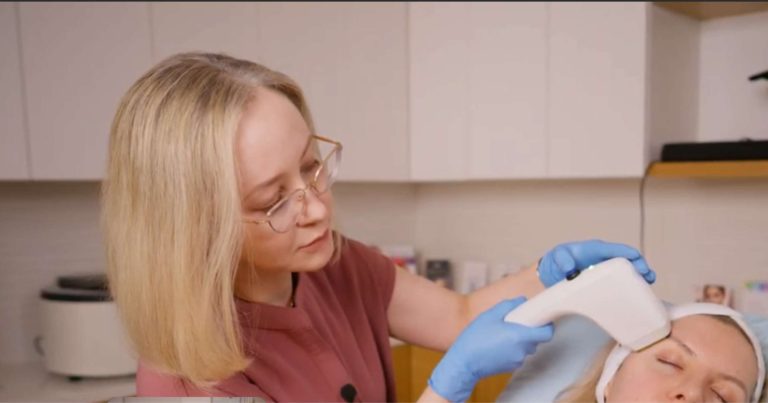
Sofwave is an FDA-cleared ultrasound device that delivers focused energy at exactly 1.5 mm depth in the mid-dermis — where collagen remodeling is most effective. It stimulates new collagen and elastin production from within, improving firmness and lift over weeks to months after treatment. A built-in cooling system protects the skin surface throughout, so there is no surface damage and no downtime.
Unlike Ultherapy, which penetrates deeper and is generally more uncomfortable, Sofwave is well-tolerated and requires a single session in most cases. It is safe for all skin types including skin of color — a significant advantage over some laser-based alternatives.
What should I know about skincare before starting cosmetic treatments?
Skincare and cosmetic treatments are not separate strategies — they work together. Retinoids improve skin texture and collagen turnover, making injectable and device-based treatments more effective over time. Sunscreen is non-negotiable: UV exposure accelerates exactly the collagen breakdown that cosmetic treatments aim to address. Medical-grade skincare prescribed by a dermatologist is meaningfully different from over-the-counter products in both ingredient concentration and formulation stability. At Dermatology Circle, skincare is often part of the same plan as injectable or device-based treatment — not an afterthought.
Practical questions
How much does a cosmetic consultation cost in NYC?
Cosmetic consultation fees at physician-led practices in New York City typically range from $150 to $500, reflecting the time and expertise of a full physician assessment. At Dermatology Circle, the consultation fee covers a full skin and facial assessment, UV light imaging where appropriate, and a personalized treatment plan. Discounts are available for returning patients and bundled treatment plans.
How much do treatments cost in NYC?
Botox in New York City is typically priced per unit, with costs generally ranging from $15 to $25 per unit at physician-led practices. A treatment session — depending on the areas — might involve 20 to 60 units. Dermal fillers are priced per syringe, ranging from roughly $800 to $1,500 depending on the product and provider. Skin tightening with Sofwave typically ranges from $1,500 to $3,000 depending on the number of areas treated. These are estimates — precise pricing is confirmed at your consultation.
Does insurance cover cosmetic procedures?
No. Cosmetic procedures are elective and not covered by insurance regardless of the provider or product. Financing is available through CareCredit at Dermatology Circle.
What should I do if I’m unhappy with a result?
Contact your practice immediately. Most cosmetic concerns — swelling, asymmetry, unexpected outcomes — are temporary and resolve on their own, or can be addressed at a follow-up visit. Hyaluronic acid fillers can be partially or fully dissolved with hyaluronidase, which is an important safety advantage of this product type. The key is choosing a practice where your physician is accessible and responsive after treatment — not just during it.
What happens to my face if I stop treatments?
One of the most common anxieties about starting cosmetic treatments is the fear of looking dramatically worse if you stop. This is generally unfounded. If you stop Botox, muscle activity gradually returns to its previous level — your face does not worsen beyond where it would have been without treatment. If you stop fillers, the product metabolizes and the area returns to its pre-treatment state. The skin does not sag more rapidly because of prior filler use. Results from collagen-stimulating treatments like Sofwave and Sculptra are maintained longer because they work through your own biology rather than a foreign substance.
How do I know if a cosmetic practice is the right fit for me?
A few things to look for before booking anywhere. The physician should ask more questions than they answer in the first few minutes. They should examine your whole face, not just the specific area you mentioned. They should be able to tell you clearly what they would not recommend for you and why. You should feel, at the end of the consultation, that the plan was designed for your face — not for a revenue target.
A practice that moves you toward a treatment before understanding your history, your skin, and your goals is not the right fit regardless of how impressive the before-and-afters look.
For a deeper explanation of what a physician-led cosmetic approach means in practice — and why the medical background of your provider shapes your outcomes — see our cosmetic dermatology philosophy page.