Written by Dr. Viktoryia Kazlouskaya, MD/PhD, FAAD
Why Regenerative Treatments Are Drawing Attention
People are living longer, overall health is improving, and expectations around aging are changing. Many patients today are not trying to look dramatically different. They want to look healthy, rested, and natural — in a way that reflects how they feel on the inside.
In aesthetic dermatology and hair loss medicine, this shift is especially noticeable. Patients are thinking less about quick fixes and more about long-term skin quality, skin and hair health, and facial aging over time.
Traditional dermatologic medical and cosmetic treatments — including medications, injectables, lasers, and other energy-based devices — remain effective and important. However, they often involve trade-offs such as downtime, side effects, and ongoing maintenance. Patients are asking more and more if there are ways to help the body heal itself. They want to know if they can support their own repair processes instead of needing outside help all the time.
This interest reflects broader trends across medicine, where researchers explore biologically informed and regenerative medicine approaches. In dermatology, this has included platelet-rich plasma (PRP), commercially derived and self-derived exosomes, and polynucleotides (PDRNs). Recently, interest has grown in secretomes.
This curiosity is not about trends or novelty. It reflects a desire for thoughtful, individualized care that prioritizes safety, restraint, and realistic expectations.
What Are Secretomes — and How Do They Differ From Exosomes?
Secretomes refer to the complete set of signaling substances released by stem cells. These include proteins, cytokines, growth factors, and microscopic particles known as extracellular vesicles, including exosomes.
Rather than acting through a single pathway, secretomes represent a complex signaling environment. They describe how cells communicate with one another and influence surrounding tissue behavior. This wider view explains why researchers see secretomes as a way to regenerate, not just as one product or treatment.
Exosomes are only one part of this system. They are small vesicles that carry specific signals, like RNA and proteins. These signals are meant to influence certain cell responses. While exosomes have received significant attention, they function within a much larger biological context.
Understanding this difference helps explain why secretomes are important for cell communication. They are not just one way for cells to talk to each other. Instead, they represent a broader method of communication.
Autologous vs Donor-Derived Regenerative Products
Regenerative products can come from a patient’s own tissues (autologous) or from outside donors (donor-derived). Each approach has potential advantages and limitations, which is why careful evaluation is essential.
Donor-derived products usually come from tissue banks or commercial labs. They need strict sourcing, screening, and quality controls. Even with safety measures, donor materials can differ biologically. They may also have potential risks linked to immune response or contamination.
Autologous approaches rely on a patient’s own biological material, commonly blood, fat, or other tissues. Because the patient provides the source, concerns related to immune compatibility decrease. However, some methods require more invasive collection techniques, which may involve additional discomfort or recovery.
More recent regenerative research has explored autologous sources that are easier to obtain. Certain laboratories, including Acorn, have developed methods to derive biologically active signaling components from hair follicles. Hair follicles are readily accessible and contain stem cells involved in normal skin and hair biology. Collection typically involves obtaining a small number of hairs with intact roots and does not require surgical harvesting.
Researchers process these follicles under controlled laboratory conditions to collect cell-released signaling factors – secretomes. They can be used for cosmetic or research purposes and applied to the skin or scalp for skin rejuvenation. Experts consider this process within a consultation-based, evaluative framework rather than as a standardized medical treatment.
The choice between using a patient’s own cells or donor cells is not about which is “better.” It is about which option is best for each patient and their specific situation.
What the Science Currently Supports — and What It Does Not
Research into secretomes is still in its early stages. At present, secretome-based approaches are discussed primarily in cosmetic or investigational settings, with clinical data and clinical experience continuing to evolve.
Large-scale, long-term clinical trials with standardized protocols are limited. Most current human experience comes from small patient groups in specific clinical settings. It does not come from large, randomized studies.
Laboratory research has studied hair follicle stem cells. This includes how they can change into different types of cells in controlled settings. These findings are important, but we need more data. This will help us understand how follicle stem cells can improve hair and skin health.
A responsible dermatologic approach recognizes both the promise and the limitations of emerging regenerative ideas and emphasizes transparency, careful patient selection, and ongoing evaluation.
Potential Applications of Secretomes in Aesthetic Dermatology and Hair Loss
In skin care products, we are interested in whether active signaling factors, including secretomes, can help with treatments. These factors may support the skin’s response to procedures like laser resurfacing. They might also improve overall skin quality and resilience.
In hair care, researchers test follicle stem cell-derived secretomes for early thinning, hair follicle health, or poor hair quality.
These potential applications remain an area of interest and active investigation. Regenerative methods should not take the place of proven treatments. However, they can be used in some cases. They may be part of a larger, personalized plan that focuses on long-term tissue health.
Safety, Ethics, and Regulatory Considerations
Autologous secretome-based approaches are not FDA-approved in the USA as medical treatments. Their discussion and consideration may occur in cosmetic, investigational, or topical contexts, which makes transparency and professional judgment essential.
Ethical dermatologic care requires a clear distinction between established medical treatments and emerging biologic concepts. Patients should understand what is known, what remains uncertain, and where scientific evidence continues to evolve.
Responsible care emphasizes informed consent, conservative application, careful patient selection, and ongoing reassessment. Not every patient is a candidate, and not every concern warrants an emerging approach.
Transparency is not a limitation — it is a prerequisite for trust.
Who May Be Interested in a Regenerative Dermatology or Hair Loss Consultation
A regenerative cosmetic or hair loss consultation may be of interest to patients who are curious about biologically informed approaches and value thoughtful evaluation over quick solutions.
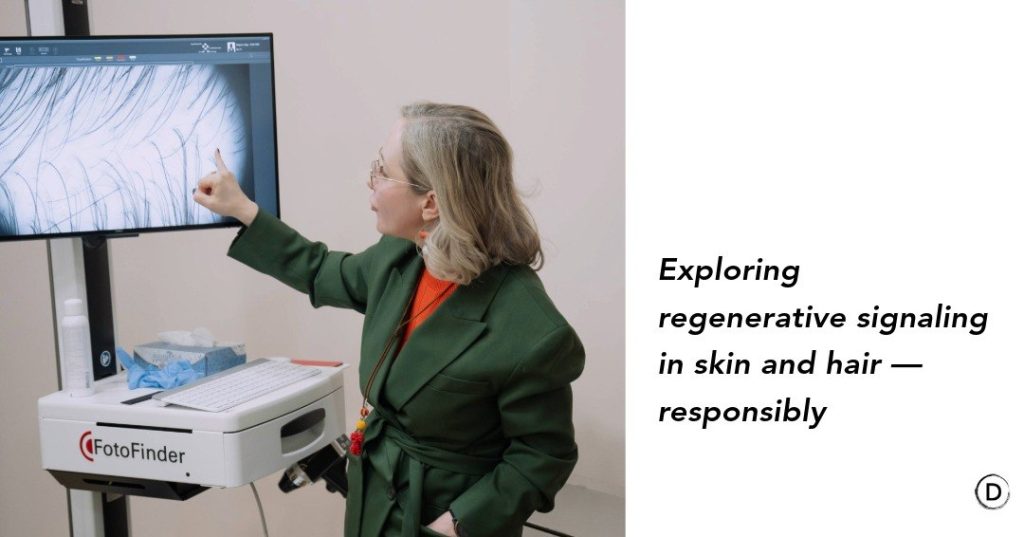
In our practice, consultations are comprehensive and include discussion of established medical treatments, cosmetic options, and emerging regenerative concepts when appropriate. Advanced imaging and AI analysis help us look at changes in skin and hair over time. They also guide personalized decisions.
This process is best suited for patients who appreciate individualized care, discretion, and long-term planning. Not every patient can use regenerative treatments. Good care means knowing when other options are better.
Why a Dermatologist-Led Approach Matters
Dermatologists are medically trained specialists in the biology and diseases of the skin, hair, and nails. This foundation is essential when evaluating emerging regenerative concepts, where understanding mechanisms, limitations, and risks matters as much as innovation.
Our clinic combines expertise in aesthetic dermatology and hair loss medicine with a strong medical background. We depend on careful assessment, clear measurement, advanced imaging, and long-term follow-up to make decisions. We do this instead of using trends or assumptions.
A dermatologist-led approach prioritizes judgment, restraint, and accountability, qualities that are especially important when navigating new and evolving areas of care.