Written and reviewed by Dr. Viktoryia Kazlouskaya, MD/PhD, Double Board-Certified Dermatologist, Dermatology Circle, Upper East Side, New York
Something significant happened this month in aesthetic medicine. Radiesse, a biostimulatory injectable with over two decades of clinical history, received FDA approval for the treatment of wrinkles in the décolletage area. It is now the first and only biostimulator in the United States with an on-label indication for both the face and the body.
Why the décolletage ages the way it does
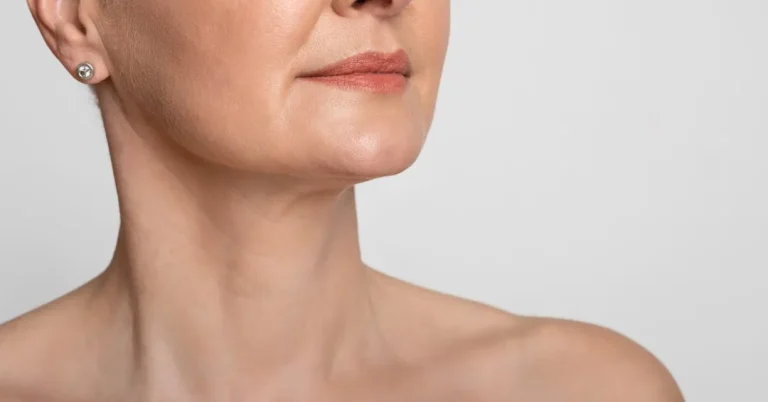
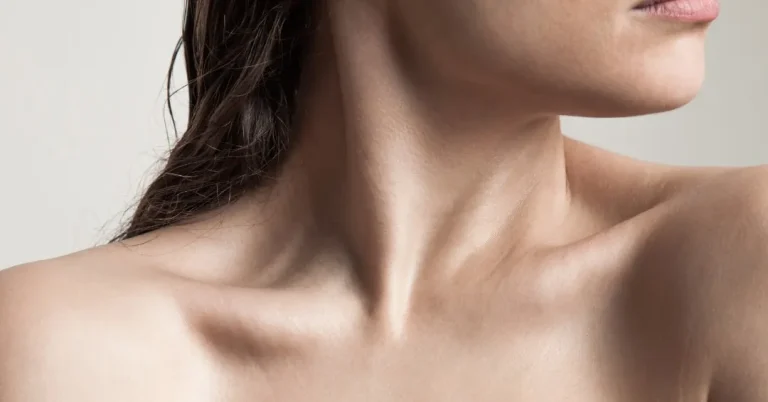
The skin of the chest and neck is structurally thinner than facial skin. For many people, the décolletage looks significantly older than the face above it.
The underlying cause of most décolletage aging is collagen and elastin decline. Once this process is underway, topical skincare can slow it, but cannot reverse it meaningfully. This is where Radiesse comes in.
What Radiesse actually does
Radiesse is not a filler in the conventional sense. Hyaluronic acid products, like Juvederm or Restylane, work by adding volume directly. They hydrate the tissue, plump the skin, and soften lines through physical presence. When they dissolve, the effect goes with them.
Radiesse works differently. Its active component is calcium hydroxylapatite, the same mineral that forms the natural structure of bones and teeth, and it is fully biocompatible and biodegradable. When injected, it does not simply add volume. It activates your skin’s own fibroblasts, the cells responsible for producing collagen and elastin, rebuilding your skin’s structural foundation from within.
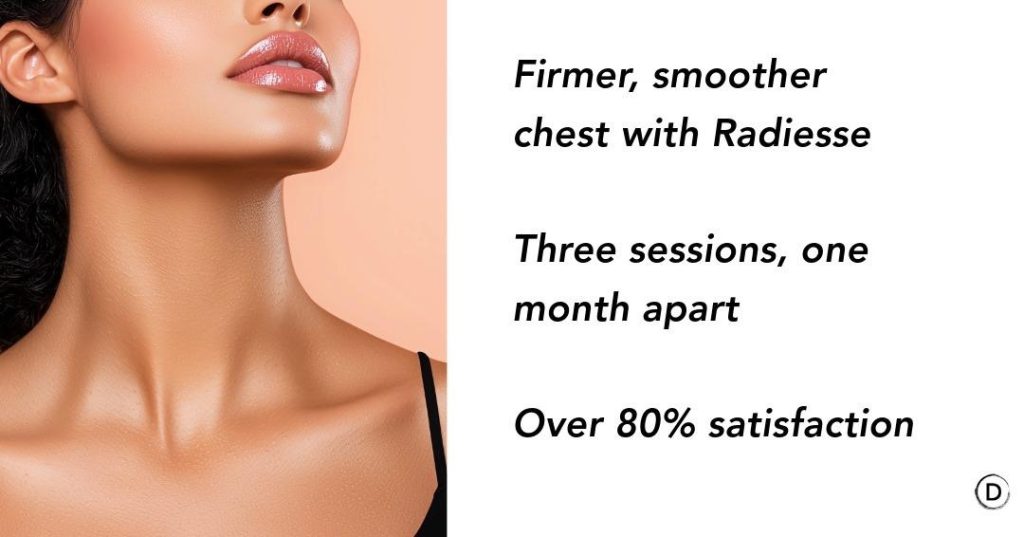
The improvement is not immediate. It develops gradually over weeks and months as new collagen forms. But because the improvement is structural, it is also more durable. Clinical data from the studies supporting the FDA approval show that results can last up to two years, with more than 80% of patients satisfied with skin tightness and improvements maintained well beyond a year in most cases.
Who is this treatment for? The answer may surprise you
One key finding from clinical research on Radiesse for the neck and décolletage is the wider age range included.
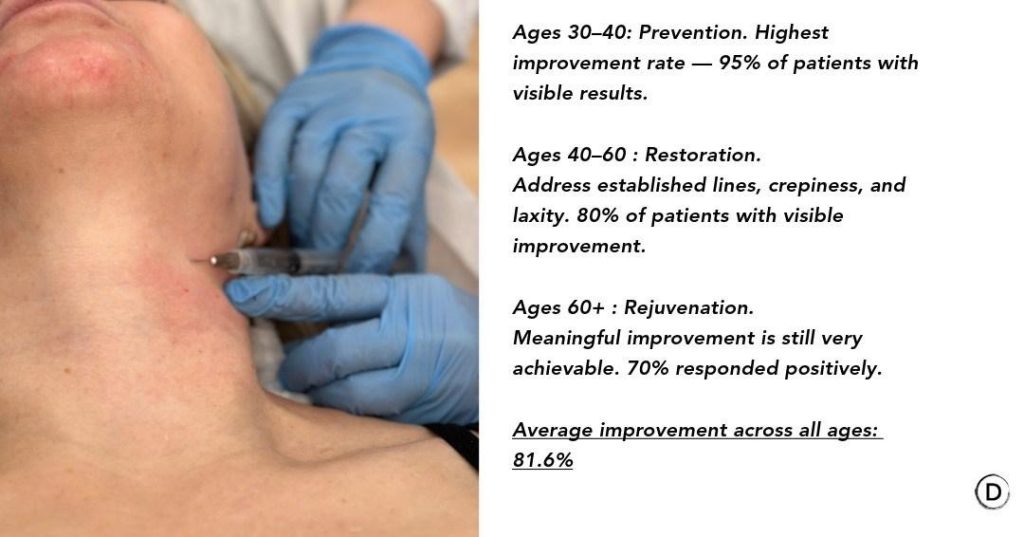
A published case series in Clinical, Cosmetic and Investigational Dermatology examined Radiesse for the neck, décolletage, and face across three distinct patient groups — those in their 30s and 40s, those between 40 and 60, and patients over 60. The results were clear: visible improvement was seen in 95% of younger patients, 80% of middle-aged patients, and 70% of older patients, with an average improvement of 81.6% across all groups.
What this tells us is that Radiesse for the décolletage is not only a treatment for established aging. It is also a meaningful preventive intervention, making future aging slower and less visible.
In clinical practice, this means two distinct approaches:
For patients in their 30s and early 40s, the goal is prevention. The skin still has good baseline quality, but collagen production has already diminished. At this stage, Radiesse proactively maintains the skin’s structural foundation and slows the visible aging process before it becomes established.
For patients in their 40s, 50s, 60s, and beyond, the goal is restoration. Lines, crepiness, and laxity are addressed directly, with meaningful visible improvement in skin firmness, texture, and brightness. The treatment does not reverse decades of aging in one session. In this age group, I often combine Radiesse with other treatment modalities (see our neck rejuvenation page).
It produces gradual, natural improvement that patients and their physicians can observe during treatment.
Almost everyone is a candidate, which is genuinely unusual for an aesthetic treatment. The specific approach is adjusted based on age, skin thickness, and the degree of change present, but the treatment itself is broadly appropriate for adults across a wide range of ages and skin types.
What the treatment involves
Radiesse for the décolletage is used in what is called a hyperdiluted form. The product is diluted with saline before injection, which serves two important purposes.
First, it allows the product to spread more evenly across the larger surface area of the chest rather than concentrating at individual injection points. Second, it exclusively stimulates collagen without adding volume. The result is skin remodeling without any puffiness or change in contour.
The injections are performed at a very superficial level. The treatment is generally well-tolerated. Minor temporary bruising, redness, or mild discomfort at injection sites is the most commonly reported side effect, typically resolving within a day or two. No significant adverse effects were reported in the published clinical literature.
Following treatment, the physician performs an immediate, gentle massage of the treated area to ensure even distribution of the product. Patients are asked to continue this self-massage twice daily for three to seven days afterward.
How many sessions do you need?
I recommend at least three sessions. They are typically spaced approximately one month apart, followed by maintenance every twelve to eighteen months. Patients typically begin noticing visible improvement after the second session, with the full result apparent at three to six months.
A patient with more prominent skin changes may need more sessions and the addition of other treatment modalities to the protocol.
Why must Radiesse be injected by a physician?
Unlike hyaluronic acid fillers, Radiesse cannot be dissolved. This makes the skill, clinical judgment, and experience of the injector absolutely critical.
The dilution ratio must be matched to the patient’s age, skin thickness, and treatment goals. The technique must ensure even distribution across the entire treatment area.
In my practice, every patient receives a full medical and cosmetic evaluation of the neck and chest before any treatment plan is designed. The décolletage is an area where I look carefully for skin changes that may require medical attention before cosmetic treatment begins. The cosmetic plan is always built around your individual anatomy, not a generic approach.
The timing question: when to start?
The clinical evidence is clear on this point: earlier is better, within reason.
Patients who begin Radiesse décolletage treatment in their 30s and 40s as a preventive measure are maintaining a structural foundation that is still largely intact. The collagen stimulation from treatment compounds with the natural collagen the skin is still producing at this stage, producing results that are both more efficient and longer lasting.
Patients who begin treatment later also benefit. The 70 to 80% improvement rates in older age groups confirm this. But the work involved is greater, more sessions may be needed, and the starting point is lower.
What does FDA approval mean?
Before April 2026, Radiesse was used for the décolletage based on physician’s clinical judgment and a growing body of published evidence, which is called off-label use. The treatment worked, the evidence was strong, and experienced physicians had been administering it safely for years. But the FDA approval changes the clinical landscape in a meaningful way.
Merz conducted and submitted clinical trials specifically for décolletage treatment to the FDA, which reviewed and accepted the data. For patients, this means a higher level of regulatory validation for this specific use. For physicians, it means clearer clinical guidance and a stronger foundation for patient conversations.
If you have been noticing changes in your neck and chest
A consultation at Dermatology Circle is the right place to start. I evaluate neck and décolletage, and if Radiesse is appropriate for you, I will design a plan specifically for your skin, your age, and your goals.