Written by Dr. Viktoryia Kazlouskaya, MD, PhD | Board-Certified Dermatologist | Dermatology Circle NYC, Upper East Side
Barely a week passes in my practice without a patient arriving with a list of device names gathered from Google searches, social media, and magazine features. These include Sofwave, Ultherapy, XERF, Morpheus8, Thermage, Emface, and Fraxel. Patients ask a perfectly reasonable question: “What is the actual difference between all of these?”
The market for non-surgical skin tightening has expanded rapidly, and new names appear and disappear quickly. But it is important to understand that each device works through a different mechanism, targets a different layer of the skin, and is suited to a different patient profile. Choosing the wrong one is not just a wasted investment. It is a missed opportunity to treat what your skin actually needs.
At Dermatology Circle NYC, Sofwave has become a preferred option. I often treat Upper East Side professionals who want real, lasting results with no downtime and no drama. But I also want my patients to understand technologies. This post explains each device honestly so you can come to your consultation already informed.
What Is Skin Tightening, and How Does It Work?
Every device in this category delivers controlled heat to specific skin layers. This triggers the body’s natural repair response. When tissue is precisely heated, collagen fibers contract and reorganize, and fibroblasts (the cells responsible for producing collagen and elastin) are stimulated to generate new structural proteins. The skin becomes firmer, tighter, and more lifted over the following months.
The critical variable is where that heat is delivered, how precisely, and what it means for the tissues above and below the target zone. This is where the devices diverge significantly.
How Do Tightening Devices Work?
The main energy types in this category are focused ultrasound, radiofrequency (RF), RF microneedling, and laser. Each interacts with tissue differently, penetrates to a different depth, and carries its own comfort and safety profile.
Sofwave: Our Device of Choice at Dermatology Circle
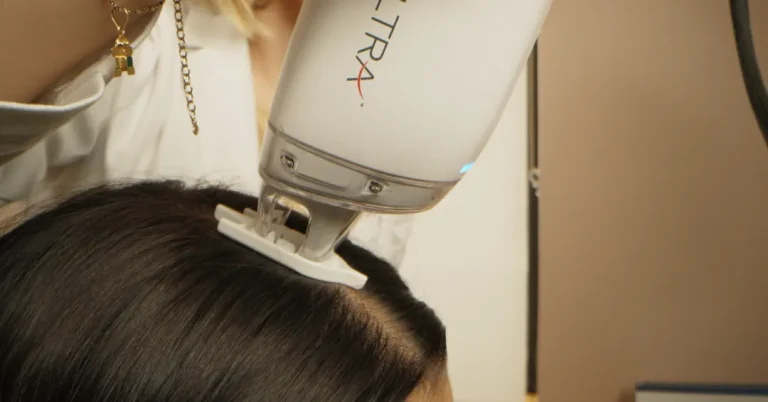
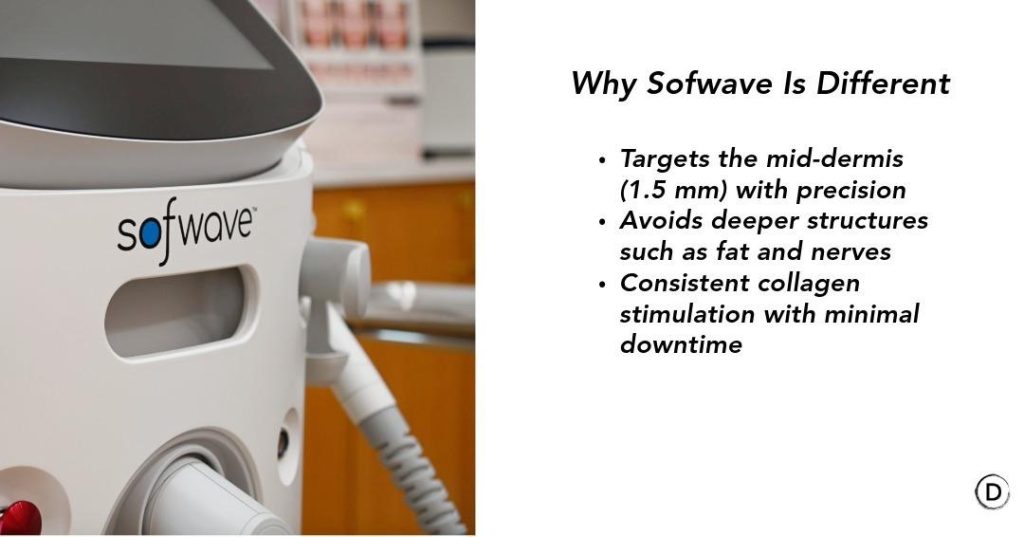
It works by delivering focused ultrasound energy to the mid-dermis (1.5 mm in depth), the layer where collagen-producing cells are most active. This allows for stimulation, improved firmness, and visible support, all without disrupting the surface of the skin or requiring downtime. For many of my patients, professionals, executives, and individuals who cannot take visible downtime, this balance matters.
Sofwave vs. Ultherapy
Ulthrapy vs Sofwave: this is the comparison patients ask about most often. Both devices use ultrasound, both are non-invasive, and both are designed for skin tightening.
Ultherapy can deliver energy at multiple depths from 1.5mm down to 4.5mm, reaching the SMAS layer, the same fibromuscular layer that is tightened surgically during a facelift. For patients with significant structural ptosis, that depth can be beneficial.
For patients with early-to-moderate laxity, however, that additional depth is often not necessary, and it comes with a cost. Ultherapy is significantly more uncomfortable than Sofwave and lasts longer (60-90 min vs 30-45 min). The deeper the energy travels, the more intensely it is felt.
Oral pain medication or nerve blocks are routinely recommended before Ultherapy. Sofwave, by contrast, in most cases, requires only topical numbing cream, and our practice has additional comfort options available when needed.
The deeper Ultherapy penetrates, the closer it gets to facial nerves and subcutaneous fat. When performed by an inexperienced provider, energy misdirected toward fat can cause focal fat dissolution, creating a hollow, deflated appearance that is difficult to correct. This risk is not hypothetical; it is a recognized complication in literature. Sofwave’s fixed 1.5mm depth keeps it entirely within the dermis, away from all critical deeper structures.
Sofwave vs. XERF
XERF is the newest device in this space and one I want to address directly, because it is generating significant buzz right now.
XERF is by Cynosure/Lutronic and represents the first multifrequency monopolar RF platform. It combines two radiofrequency frequencies simultaneously: 6.78 MHz, which targets the dermis, and 2 MHz, which penetrates deeper toward the SMAS plane.
Reaching multiple depths with a single RF pass is promising, but it may lead to fat loss when working on the deeper compartments.
Additionally, XERF only entered the US market in mid-2024, and its long-term data is not yet available. That said, I am watching XERF closely. As more peer-reviewed data emerges and as experienced dermatologists publish long-term outcomes, the picture will become clearer.
Sofwave vs. Thermage
Thermage uses monopolar radiofrequency to heat the dermis and subcutaneous tissue up to 4.5 mm. Thermage heats a broad volume of tissue through bulk heating, relying on that diffuse thermal effect to stimulate collagen remodeling across a wider area. With the depth of the treatment, the risk of side effects is similar to Ultherapy.
Thermage remains a respected option with a long clinical history, particularly for diffuse skin quality improvement, though it is less targeted than newer technologies.
Sofwave vs. Emface
Emface is categorically different from Sofwave, and the comparison requires a brief explanation of what Emface actually does, because patients frequently misunderstand it.
Emface uses two technologies simultaneously: radiofrequency to heat the dermis and stimulate collagen, and synchronized electrical muscle stimulation to stimulate and tone the underlying facial muscles. Its primary goal is not skin laxity in the traditional sense, but muscle stimulation and tone, treating the muscular foundation of the face rather than the skin itself. These treatments are addressing fundamentally different concerns.
There are also structural differences in the treatment course. Emface is not a single-session treatment; it requires four sessions at weekly intervals to achieve its intended effect.
Sofwave vs. Morpheus8
Morpheus8 is one of the most searched comparisons, and it is also one of the most commonly misunderstood. Morpheus8 is not, strictly speaking, a skin-tightening device. It is an RF microneedling device, and that distinction matters enormously.
Morpheus8 uses an array of gold-tipped microneedles to physically penetrate the skin and deliver radiofrequency energy from 1mm to 4mm depth. The combination of mechanical micro-injury and thermal RF stimulation produces both collagen remodeling and tissue contraction. It also remodels fat in the areas it treats.
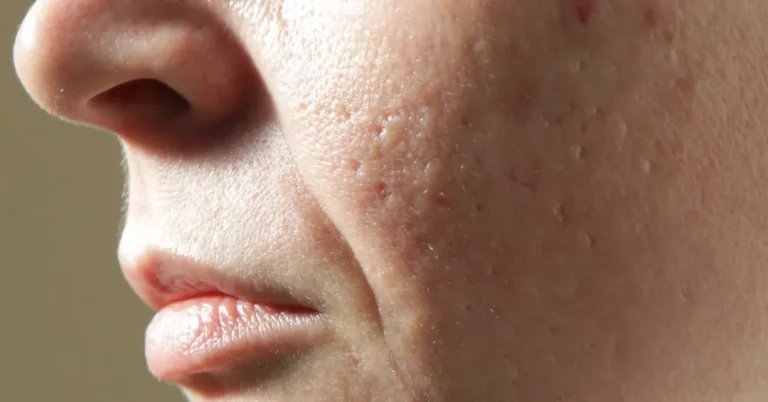
Morpheus8 is particularly effective for surface and textural concerns: acne scarring, coarse texture, enlarged pores, and deeper structural remodeling where fat remodeling is desired alongside tightening. It is a powerful tool for the right patient.
Because Morpheus8 physically penetrates the skin surface, patients typically experience several days of redness, pinpoint bleeding, swelling, and sensitivity. Makeup and exercise are off limits for several days. For my Upper East Side patients who cannot afford visible recovery, this is often a dealbreaker.
There is also an important safety note worth acknowledging. In October 2025, the FDA issued Safety Communication on potential risks associated with certain uses of RF microneedling devices, including reports of serious adverse events. These risks are primarily linked to improper depth settings, inadequate training, and use by non-physician providers. They are not reasons to categorically avoid technology, but they are reasons to choose your provider with great care if you pursue it.
Sofwave vs. Fraxel
Fraxel is a fractional laser (specifically a 1550nm non-ablative erbium fiber laser) designed for skin resurfacing. It targets water in the skin to create thousands of microscopic columns of thermal injury, triggering a healing response that improves texture, tone, pigmentation, and fine lines.
Fraxel is excellent at what it does. For sun damage, melasma, acne scarring, rough texture, and fine lines caused by surface-level changes, Fraxel produces real, clinically meaningful improvements that ultrasound-based tightening cannot match.
What Fraxel does not do is lift or tighten structurally lax skin. It works at and near the skin surface. It does not stimulate collagen at the mid-dermal depth in the way Sofwave does, and it does not produce the lifting effect along the jawline, brow, or neck that Sofwave achieves.
Downtime with Fraxel is typically five to seven days of redness, swelling, and peeling, depending on the treatment intensity.
So Which Device Is Right for You?
Every face is different, and the right treatment begins with understanding yours. Patients often arrive with a preference for a particular device. My role is to assess the face carefully and determine which treatment, if any, is most appropriate for that individual.
For many patients considering non-surgical skin tightening in New York City, the decision is not simply about effectiveness. It is about predictability, recovery, and whether results appear refined rather than obvious. The best treatment is not the most aggressive. It is the one that aligns with both the anatomy and the lifestyle of the person receiving it.
After nearly three years of clinical use, I have consistent, well-documented outcomes with Sofwave. The safety profile is excellent. The comfort profile is significantly more favorable than deeper energy-based treatments, while still producing gradual, natural, anatomically appropriate results.
I also believe in honest guidance. If a patient arrives asking for Sofwave and their face tells me they need surgery, I will say so. If their concern is acne scarring and not laxity, I will redirect them. And if a newer technology earns enough clinical evidence to change my recommendation, I will say that too.