Jawline Contouring & Jowl Treatment NYC
Written and reviewed by Dr. Viktoryia Kazlouskaya, MD/PhD, Board-Certified Dermatologist
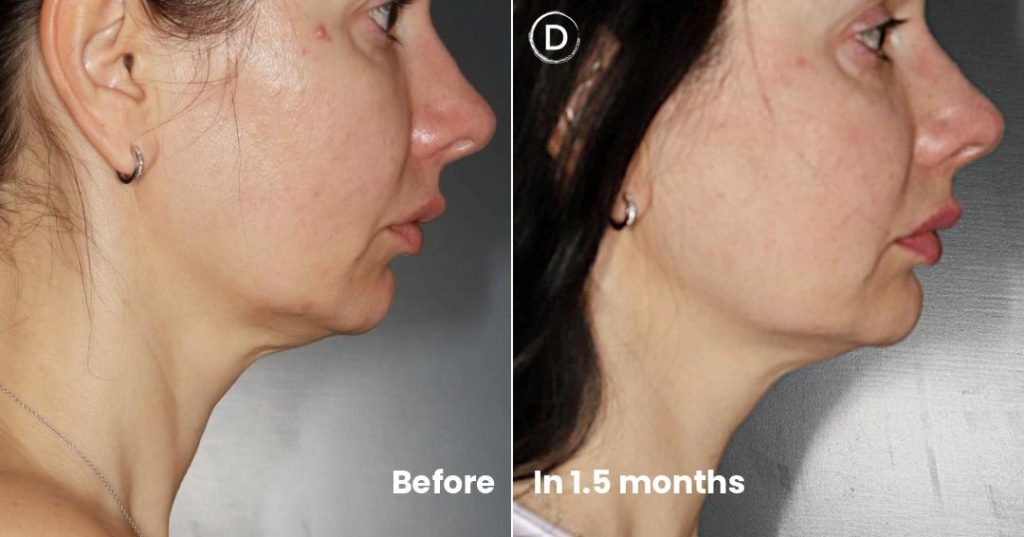
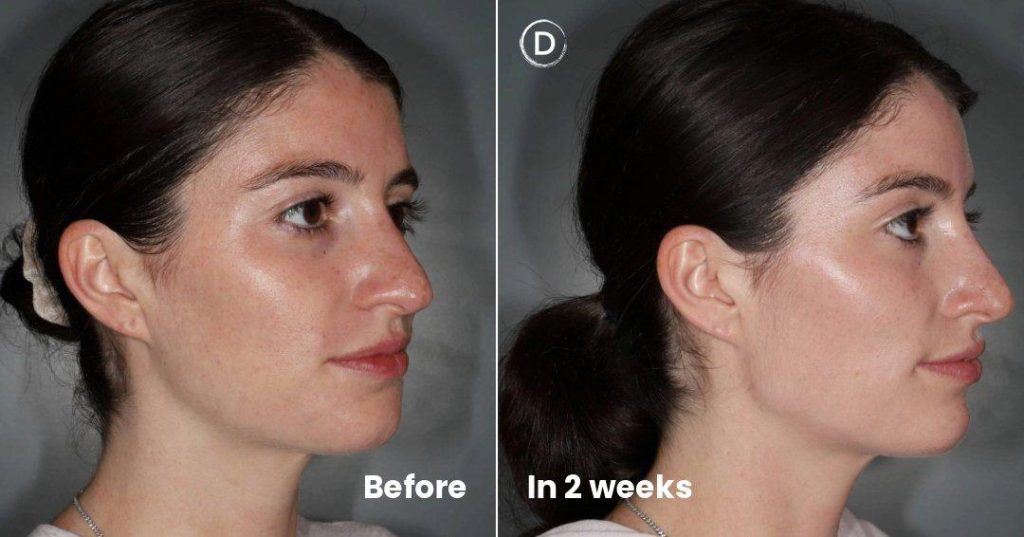
A defined jawline is one of the clearest visual markers of youth. As the jawline softens, the face can look heavier, older, and less vital. This can happen even when the upper face looks well maintained.
Many patients researching jowl treatment in NYC encounter terms such as Botox, jawline filler, Sofwave, Sculptra, Radiesse, Kybella, or the Nefertiti lift. The challenge is that none of these treatments are universally correct.
Jowls and jawline softening are not a single problem. This is one reason why lower face rejuvenation is rarely achieved with a single treatment alone. They are several distinct problems that appear identical from the outside. Treating them without that distinction produces results that are partial, imbalanced, or simply wrong.
At Dermatology Circle on the Upper East Side, jawline and jowl treatment is a clinical investigation. Before recommending any treatment, Dr. Kazlouskaya identifies which anatomical layers are responsible for the change.
Why Jawlines Change. The Full Anatomy Behind Jowls
Most patients arrive believing jowls are simply “sagging skin.” The reality is more nuanced. Jowl formation is a multi-layered process involving at least four distinct anatomical mechanisms occurring simultaneously. Identifying which combination is present in any individual patient is the foundation of a treatment plan that actually works.
The Platysma, A Muscle Pulling the Face Downward
One of the most clinically significant contributors to lower face aging is also one of the least discussed: the platysma. This broad, flat muscle runs from the chest and upper shoulder up through the neck and inserts into the lower face and chin.
With age, it tightens and exerts a continuous downward pull on the overlying soft tissue of the lower face, actively dragging the jawline, jowls, and lower cheeks with it. This is a dynamic, muscular force.
In patients where platysmal pull is a significant contributor, relaxing the muscle with Botox or another neuromodulator is often one of the most effective first steps. Strategic injections target the platysmal bands in the neck and along the lower jaw in a technique called the Nefertiti lift. These injections relax the downward pull, producing a rise of the lower face, sharpening of the jaw-to-neck transition, and softening of vertical neck banding.
A related but distinct concern is masseter hypertrophy — excessive bulk in the jaw-clenching muscles at the angles of the mandible, commonly seen in patients who grind their teeth or clench under stress. An overdeveloped masseter widens and squares the lower face. Botox to the masseter gradually reduces muscle volume over three to four months, refining the lower facial silhouette.
Bone Resorption and Collagen Loss: When the Foundation Weakens
The mandible is not static. With age, the jawbone undergoes gradual resorption, most significantly along the anterior chin, the body of the mandible, and the jaw angle. As bony support diminishes, the soft tissue above loses its structural anchor and descends.
Structural dermal fillers placed along the mandibular border and chin may support the frame. Patients researching jawline filler NYC are often surprised to learn that successful treatment is not simply about adding volume, but about restoring structural support in the correct anatomical locations.
Fat Loss and Redistribution: Volume Migrates Where You Don’t Want It
The lower face contains several distinct fat compartments, each located between ligamentous attachments that weaken with age. As these ligaments loosen, fat that once sat high and forward descends and accumulates just below the jawline. The result is fullness below the jawline and hollowing of the pre-jowl sulcus above it.
Hyaluronic acid fillers (Juvederm Volux, Restylane Contour, RHA collection, and others) are used for immediate pre-jowl correction and mandibular border definition. Product and technique selection depend on the depth of placement required, the degree of correction, and prior treatment history.
Submental Fat. The Anatomy of Lost Definition
Excess or redistributed fat in the submental space (beneath the chin) is a distinct contributor to jawline definition loss that requires its own approach. As fat accumulates or descends into this area, the angle between the underside of the chin and the neck flattens, and the separation between jaw and neck blurs. The result is the appearance of a double chin or an undefined lower face even in patients whose body weight has not changed.
Kybella (deoxycholic acid) is an FDA-approved injectable that permanently destroys fat cells in the submental area. It is also used off-label in the jowl and pre-mandibular area for patients with localized fat deposits contributing to lower face heaviness.
Unlike every other treatment on this page, Kybella reduces tissue rather than adding or remodeling it, and because destroyed fat cells do not regenerate, the reduction is permanent. Treatment typically requires two to four sessions spaced six weeks apart, with full results visible eight to twelve weeks after the final session.
Kybella is the right treatment for patients whose jowling is driven primarily by fat descent or accumulation. It is not appropriate when jowling is structural (bone resorption, collagen loss, or tissue descent without significant fat deposits).
Skin Laxity
Even when all the structural work below is done well, the skin itself must have sufficient elasticity to redrape and conform to the improved architecture beneath it. When skin elasticity is compromised, it will not adapt fully to corrections made below, and surface treatment becomes an essential component.
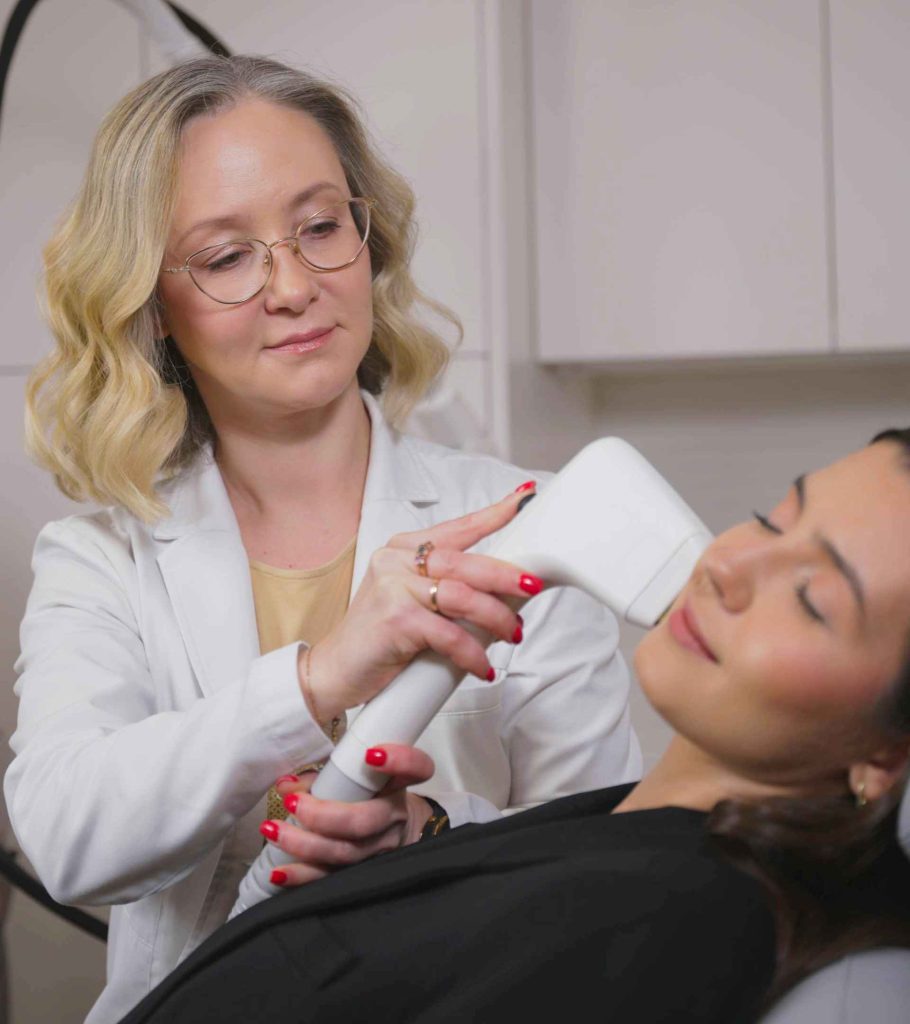
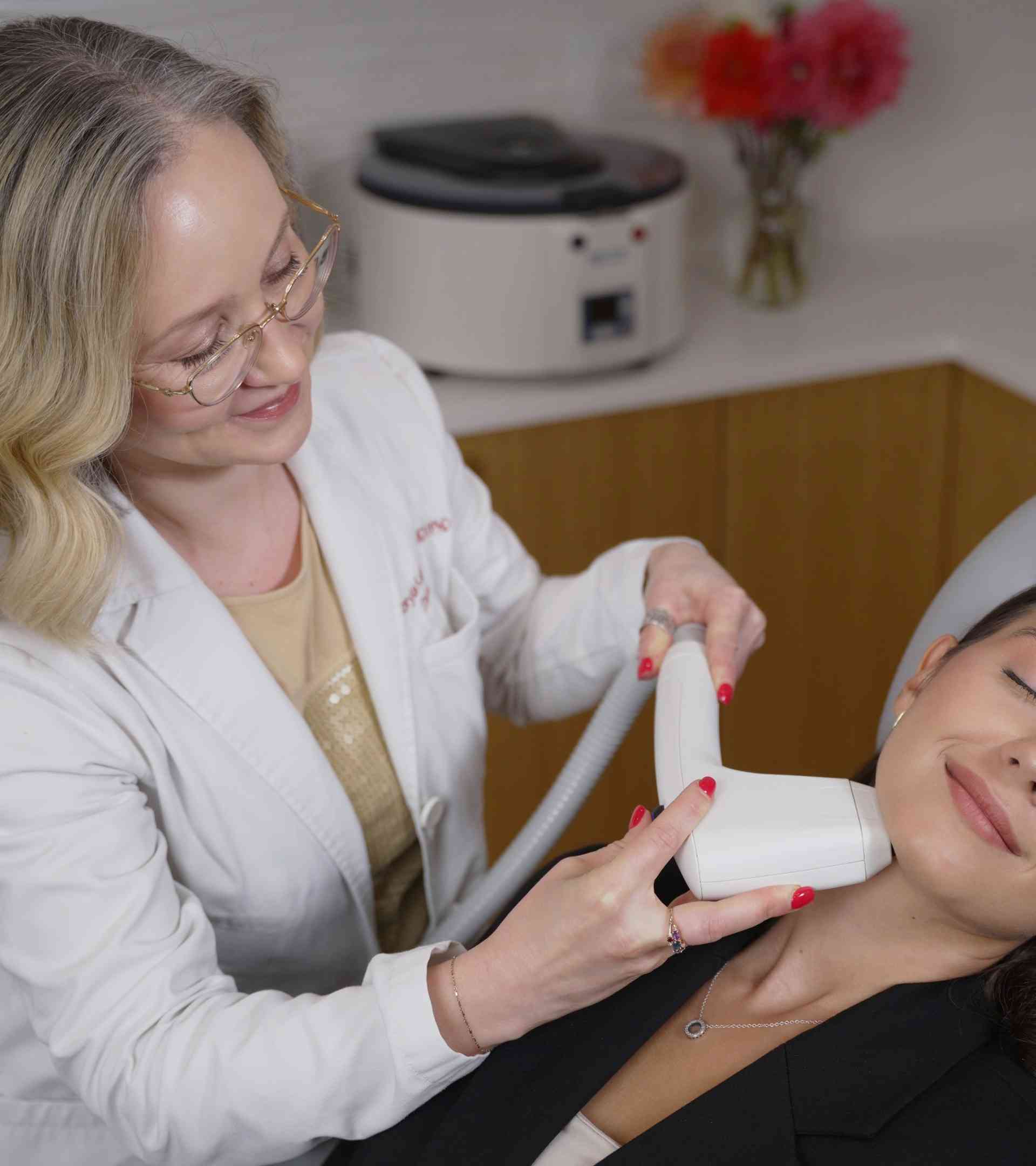
Skin laxity can be addressed with skin tightening devices. We offer ultrasound based technology (Sofwave) for patients with mild to moderate jowling. For patients with early changes, Sofwave alone may fully satisfy their goals. For patients with more established jowling, it functions as a critical component of a layered plan, ensuring the skin can maintain and conform to the structural corrections made below it.
Medical-grade skincare helps preserve collagen, support elastin remodeling, and maintain treatment results between visits. Daily sun protection, retinoid use, and individualized skincare recommendations remain an important part of long-term facial maintenance.
When Non-Surgical Treatment Has Reached Its Limits
Many patients initially seek treatment for jowls without surgery because they are not ready for a facelift or simply prefer a more conservative approach. Non-surgical jawline rejuvenation produces genuinely meaningful, natural-looking improvement in the vast majority of patients presenting with early to moderate jowling and jawline softening. But non-surgical treatment has limits that must be stated honestly.
At Dermatology Circle, this assessment is made at consultation and stated directly. Patients are never sold a multi-treatment non-surgical plan when surgery would serve them better. When a surgical referral is the right recommendation, Dr. Kazlouskaya refers to board-certified plastic surgeons whose clinical results she respects.
Male vs. Female Jawline Anatomy. Why Treatment Differs
Treatment that applies female aesthetic goals to a male patient — or vice versa — produces results that are technically correct but aesthetically wrong. The anatomical differences are real and they govern every decision in a lower face treatment plan.
The female jawline is characterized by a softer, oval-to-heart-shaped contour. The mandibular angle is less pronounced, the chin narrows to a gentle point, and the lower face tapers toward the midline.
The male jawline is defined by angularity. The mandibular angle is pronounced, the ramus is broader, the chin is wider and more square, and the lower face has more lateral and anterior projection.
Masseter Botox serves different clinical goals by sex. In women, it is commonly used to slim a wide or square lower face, softening the contour. In men, the same treatment applied without adjustment feminizes the lower face by reducing the structural muscle bulk that defines it. When masseter Botox is appropriate in male patients, dosing is conservative and intent is refinement, not slimming.
Chin augmentation differs significantly. In women, chin filler aims for subtle forward projection with a refined, slightly tapered tip. In men, the aesthetic target is broader anterior projection with a more square, defined profile, often requiring a denser product, deeper injection plane, and greater volume.
Jawline filler volume is generally higher in men. Recreating the angular, well-defined mandibular border of a youthful male face requires structural fillers placed along the entire jaw from angle to chin, typically across multiple syringes and sessions. Under-volume produces a feminized result; excess volume looks augmented. The calibration is precise and anatomy-dependent.
The Nefertiti lift applies equally in both sexes. Platysmal pull is not gender-specific, though platysmal bands tend to be more prominent in men and may require higher Botox doses to achieve comparable relaxation.
At Dermatology Circle, every lower face consultation includes an explicit assessment of gender-specific features. The goal is always gender-congruent rejuvenation: this patient, at their best, not a version of someone else’s aesthetic.
The Dermatology Circle Approach
Increasingly, patients are seeking jawline treatment not because they want to look dramatically different, but because they want their appearance to remain aligned with how energetic, healthy, and vibrant they feel. The goal is rarely transformation. It is refinement.
No two patients present with the same combination of contributing factors.
At Dermatology Circle, treatment for sagging jawline begins with standardized photography and a systematic evaluation of all four anatomical layers. Previous treatments performed elsewhere are reviewed carefully, what has been placed, where, at what depth, and how it is affecting the current appearance before anything new is considered.
For most patients seeking lower face rejuvenation NYC, Dr. Kazlouskaya recommends a staged process rather than a single appointment. Beginning with Botox and Sofwave, then assessing what remains at follow-up before adding structural correction, allows each layer to be evaluated independently and prevents over-treatment.
Who Benefits from Jawline Treatment
Late 30s to mid-40s: early prevention.
Very early softening of the jawline, beginning platysmal banding, slight pre-jowl shadow just beginning to form. This is the most efficient moment to treat, maintaining structure before significant descent requires far less correction than restoring it afterward. Nefertiti Botox combined with Sofwave and a conservative amount of structural filler typically fully satisfies this group. Prevention at this stage compounds over time.
Mid-40s to mid-50s: established jowling.
Visible jowl formation, deepening pre-jowl sulcus, meaningful loss of mandibular definition, moderate skin laxity. A full combination approach produces the most comprehensive correction. Most patients in this group benefit from Sculptra or structural mandibular filler, Nefertiti Botox, Sofwave, and Kybella where submental fat contributes. Results are staged across two to three visits and build progressively.
Mid-50s and beyond: advanced structural change.
More significant jowling, pronounced tissue descent, reduced skin elasticity. Non-surgical treatment produces real and meaningful improvement at this stage and should not be dismissed.
But patients in this group require honest assessment of what non-surgical treatment can and cannot achieve for their specific anatomy. For some, surgical referral is the most appropriate recommendation. For others, a staged non-surgical plan produces results they are genuinely satisfied with.
After GLP-1 medications or significant weight loss.
In patienets with significant weight loss, the lower face is frequently disproportionately affected. The treatment approach is identical but typically needs to be more comprehensive and staged over multiple visits to address the degree and pace of change.
Male patients.
Men often delay presentation and arrive with more advanced structural change than female patients at the same age. Treatment goals (angular definition, structural projection, mandibular sharpness) differ substantially from female goals, and dosing, product selection, and aesthetic calibration are adjusted accordingly. Male patients can achieve significant, natural-looking jawline restoration; the approach simply requires different parameters.
You've been thinking about this long enough
A conversation is the right place to start.
Frequently Asked Questions
What is the best non-surgical treatment for jowls in NYC?
There is no universally best treatment, because jowls have multiple causes and each requires a specific approach. For most patients, a combination plan produces the best outcome. The specific components depend entirely on what is identified at consultation. A plan built around an accurate assessment always outperforms a popular treatment applied without one.
What is the Nefertiti lift and how long does it last?
The Nefertiti lift is a Botox technique targeting the platysma. Botox is injected along the inferior mandibular border and into the vertical platysmal bands of the neck, relaxing the downward tension and allowing the lower face to sit higher.
What is Kybella and when is it appropriate for jowls?
Kybella (deoxycholic acid) is an FDA-approved injectable that permanently destroys fat cells in the submental area. It is also used off-label in the jowl and pre-mandibular region for patients with localized fat deposits contributing to lower face heaviness.
How does Sofwave treat the jawline and jowls?
Sofwave delivers focused ultrasound energy to a precise depth within the mid-dermis, stimulating new collagen and elastin production. It improves the quality, firmness, and elasticity of the skin itself, allowing it to better conform to and maintain the structural corrections made below it.
Which jawline filler lasts the longest?
Sculptra and Radiesse produce the most durable results — two or more years from the final session in most patients — because it works by stimulating the body’s own collagen production rather than directly volumizing. Juvederm Volux placed along the mandibular border typically last twelve to eighteen months.
But the right choice is not simply the one that lasts longest. It depends on the specific anatomical layer being addressed, the degree of change, the patient’s age and prior treatment history, and whether immediate structural correction or gradual collagen rebuilding better serves the treatment plan.
How is jawline treatment related to neck rejuvenation?
They are anatomically continuous and clinically related. The platysma connects the lower face to the neck; treating one without assessing the other produces partial results.
Can non-surgical jawline treatment replace a facelift?
For patients with early to moderate jowling and good skin elasticity, a well-designed non-surgical plan produces meaningful, natural-looking improvement that satisfies most patients and delays surgical intervention for years.
What does jawline contouring cost in NYC?
Investment varies significantly depending on which components the treatment plan includes, how many areas are addressed, and the degree of anatomical change being corrected, but usually starts around $2000.
A plan built around Botox and Sofwave carries a different investment than one incorporating Sculptra, mandibular filler, pre-jowl correction, and Kybella across multiple sessions. Pricing is confirmed at consultation once a personalized plan has been developed. Patients are never presented with a cost before a plan, because the plan always comes first.