Acne Scar Treatment · Upper East Side NYC

Acne Scar Treatment in NYC

Acne scars are not one condition, and they don't respond to one treatment. A scar's depth, shape, and cause of depression, all determine what will.

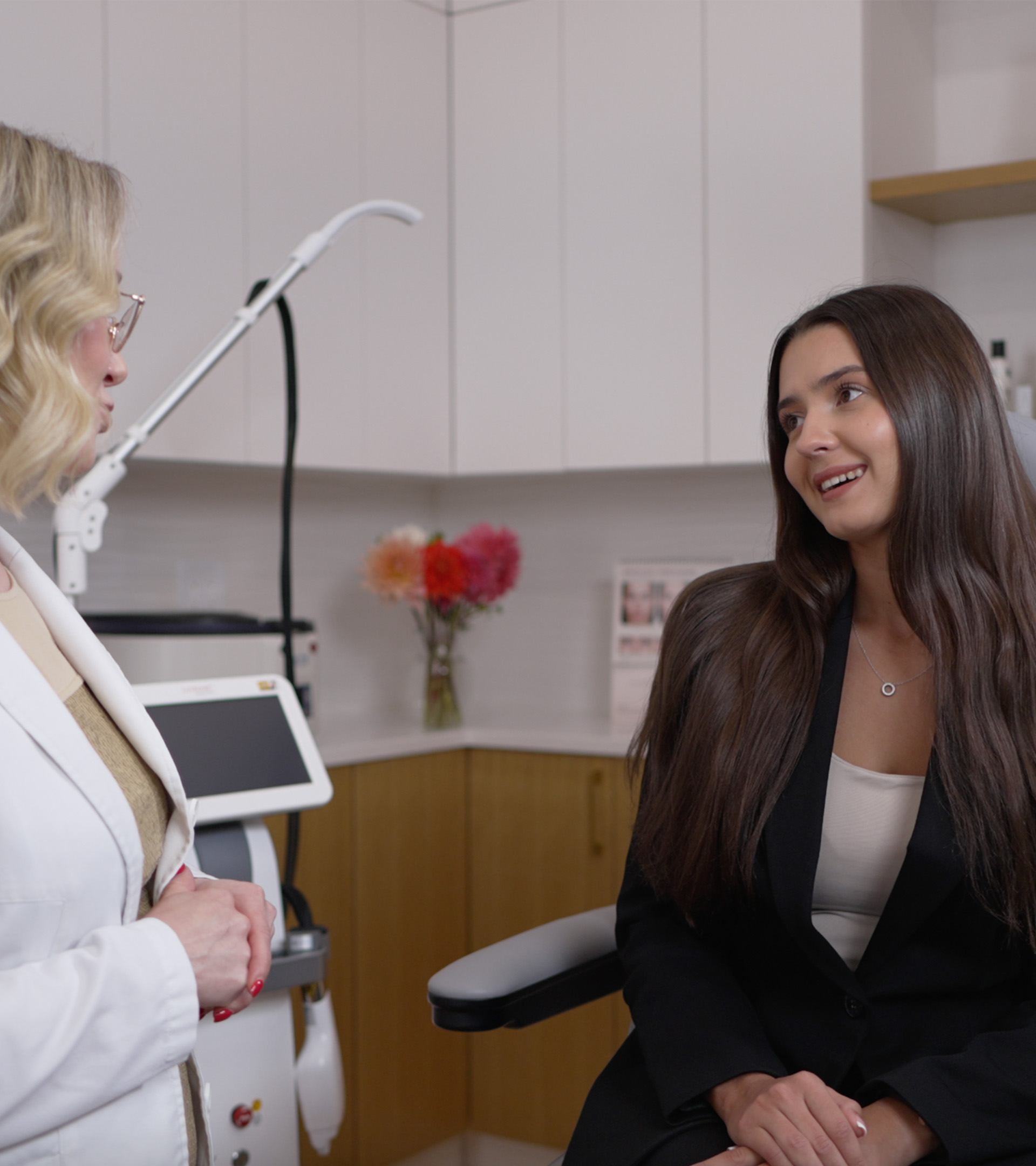
Laser resurfacing treatment for acne scars at Dermatology Circle NYC
Dermatology Circle · NYC Scar Type Before Device

At Dermatology Circle, a boutique, direct-pay practice on Madison Avenue, acne scar treatment begins with Dr. Kazlouskaya personally identifying what is actually present, then building a plan around it, not with a standing menu of devices and a technician to run them.

Why Treatment Matters

Why Acne Scars Bother People More Than the Acne Itself Did

Active breakouts fade. Scars don't, at least not on their own.

In a city built around close-up interaction — client meetings, dating, being on camera, high-definition photography, harsh apartment lighting — textural changes that would go unnoticed elsewhere can feel constantly visible. Patients frequently describe:

  • Feeling that foundation and concealer are a daily requirement rather than a choice
  • Noticing scars specifically in side lighting, video calls, or professional photography, even when others insist they don't see them
  • Avoiding certain angles, lighting, or being makeup-free in front of a partner
  • A sense that the scars are a visible record of a period of life they've otherwise moved well past

None of this is vanity — it's a legitimate reason to seek treatment, and it's worth naming directly because it also shapes what a good treatment plan looks like. A patient most bothered by how scars read in harsh overhead light has a different practical goal than one preparing for a specific event or milestone occasion, and that context belongs in the consultation, not only in the scar measurements.

Step One

Active Acne Has to Be Controlled First

Treating scars while acne is still actively producing new lesions is treating the wrong problem. New inflammatory acne can create new scars faster than a resurfacing or subcision plan can improve old ones — so before, or alongside, any scar-focused procedure, we address the acne itself.

Depending on severity, that may mean topical prescription therapy, hormonal treatment, or oral isotretinoin (Accutane) for more severe or persistent cases. Isotretinoin is often the single most effective way to stop new scars from forming, and for adults who developed or continued having acne later in life, we frequently use a lower-dose approach — see our low-dose isotretinoin for adult acne guide for how that's dosed and monitored differently than a standard course. Our acne treatment overview covers the broader medical approach beyond isotretinoin alone.

Scar correction is most effective once the acne generating new damage has been brought under control. In practice, this often means the medical (acne) and cosmetic (scar) sides of your care run in parallel, coordinated personally by the same physician rather than handled by two disconnected providers.

01
Expectations

Realistic Expectations: Improvement, Not Erasure

No responsible treatment plan promises scar-free skin. Acne scars can be made shallower, softer, and far less visible — depth, texture, and shadowing all respond meaningfully to treatment — but the honest goal is substantial improvement, not erasure. Any provider promising scars will disappear completely is setting an expectation that isn't supported by how these treatments actually work.

We go into this in more depth, along with why identifying scar type comes before choosing a device, in our full guide to acne scar treatment by scar type.

02
Diagnosis

Scars vs. Redness and Pigmentation

Many patients call anything left behind by acne a "scar," but a flat red mark (post-inflammatory erythema) or a flat brown or gray mark (post-inflammatory hyperpigmentation) is not a structural scar — it hasn't changed the skin's contour, only its color. These are typically treated differently, often with vascular lasers or chemical peels rather than resurfacing or subcision.

Sorting this out matters because treating pigmentation as if it were a structural scar — or vice versa — wastes both time and money on the wrong tool. This distinction is part of every initial evaluation.

Diagnose Before Treating

Types of Acne Scars

Acne scarring falls into two broad categories, and treatment planning starts with identifying which one — or which combination — is present.

Atrophic scars are depressions in the skin, caused by a net loss of collagen during healing: - Ice pick scars — narrow, deep, sharply defined tracts, often the hardest scar type to fully soften - Boxcar scars — wider depressions with defined edges, like shallow craters - Rolling scars — broader, shallow depressions with sloping edges caused by fibrous bands tethering skin from below

Hypertrophic and keloid scars are raised rather than depressed, caused by an overproduction of collagen during healing. Hypertrophic scars stay within the original wound border; keloid scars extend beyond it.

Each of these behaves differently, responds to different treatments, and often coexists with one or more of the others on the same face — which is why a full assessment, not a single scar's appearance, drives the plan. Our complete guide to acne scar treatment by scar type goes deeper on identifying each type and what realistically improves it.

Profile view showing acne scar texture for clinical assessment in NYC
Clinical Assessment Depth · Shape · Tethering · Skin Tone
Multi-Modality Treatment

An Individualized Range of Treatments

No single technology fits every scar, and a considered plan usually draws on several of the following, selected with precision for what is actually present rather than offered as a package.

01

Subcision.

Releases fibrous bands tethering the skin downward from below, using a needle or a blunt cannula depending on the scar. Most relevant for rolling scars where the depression is caused by an anchor point beneath the surface, not tissue loss alone.

02

Excision techniques.

For individual, well-defined scars that won't respond adequately to resurfacing: - Punch excision — the scar is surgically removed with a small circular punch and the edges closed, most useful for deep, narrow ice-pick or boxcar scars - Punch elevation — the scarred tissue is punched out, raised to the level of surrounding skin, and left to heal, preserving the patient's own skin texture rather than replacing it - Punch grafting — the excised area is filled with a small skin graft, generally reserved for deep, wide ice-pick scars - Elliptical excision — used less often, for larger or unusually shaped individual scars

Excision addresses a scar directly rather than trying to remodel it from the surface, but it is scar-by-scar, not a whole-face treatment, and it carries its own healing and pigment-change considerations that need to be discussed individually.

03

TCA CROSS.

A separate, physician-performed technique using high-strength trichloracetic acid applied precisely into the base of ice-pick or narrow deep scars, causing controlled, localized collagen remodeling.

04

Laser resurfacing.

  • Fractional CO2 — ablative, remodels surface texture and dermal collagen; see our CO2 laser recovery guide for what downtime actually looks like at different intensities
  • Fully ablative CO2 or Erbium:YAG — more aggressive resurfacing for select cases needing deeper correction, with a longer recovery
  • Non-ablative fractional lasers (e.g., Fraxel-type devices) — less downtime, more gradual improvement, useful for milder textural change or patients who can't accommodate ablative recovery
05

Microneedling

, with or without PRP. Standard microneedling creates controlled microinjury to stimulate gradual collagen remodeling with meaningfully less downtime than laser. Adding platelet-rich plasma (the patient's own concentrated growth factors) during the procedure is sometimes used to support healing and collagen response. More on our microneedling treatments.

06

Chemical peels.

Medium-depth peels (TCA-based) or, less commonly, deeper phenol peels can improve surface texture and are particularly useful for the pigmentation that frequently accompanies acne scarring.

07

Dermal fillers and biostimulators.

Hyaluronic acid filler, or biostimulators such as Sculptra or Radiesse, restore volume beneath boxcar or rolling scars that are, at their core, a localized volume deficit. This is a tool we use more deliberately than many practices, since it's frequently overlooked in favor of lasers and needling alone. See our dermal fillers page for the broader range of injectables we work with.

08

Intralesional Kenalog (steroid) injections.

For raised, hypertrophic acne scars, which behave in the opposite direction of every scar type above — they need to be softened and flattened rather than lifted or filled.

09

Silicone gel/sheeting and cryotherapy.

Adjunctive options for hypertrophic or early keloid-tendency scars, sometimes used alongside intralesional treatment rather than as a standalone approach.

10

Vascular lasers and IPL.

Not scar treatments themselves, but frequently used alongside a scar plan to address the post-inflammatory redness that often accompanies acne scarring.

A full explanation of which treatment fits which scar type, including how tethering and depth are actually assessed, is in our scar-type comparison guide.

Real Patient Cases

See How the Plan Changes With the Problem

These cases illustrate why acne scar care is often staged: first control active disease, then target the residual redness, texture and structural scarring with the appropriate modality.

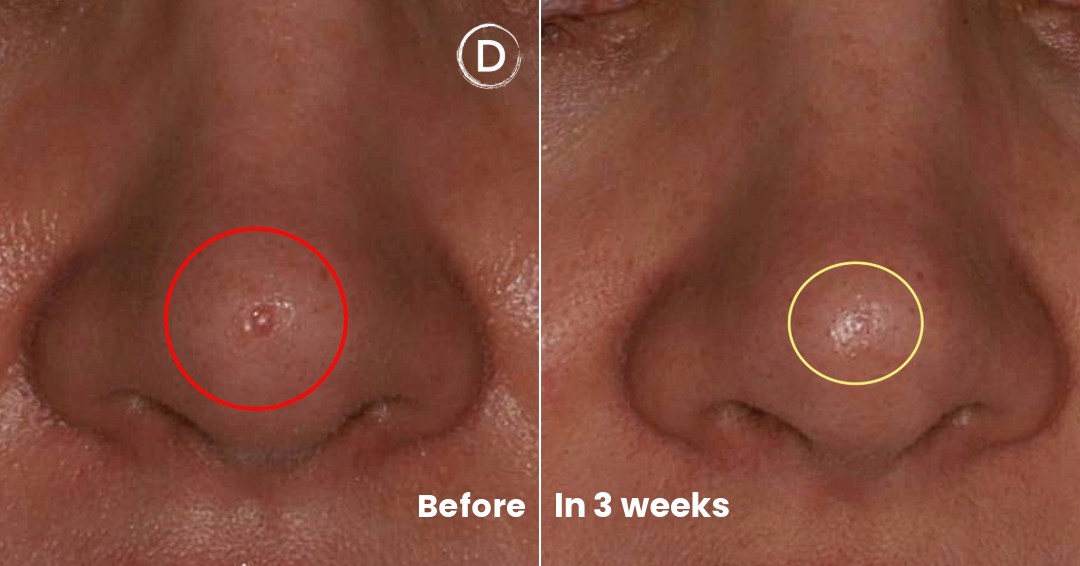
Before and after fractional CO2 treatment for post-acne scarring and texture in Asian skin Before & After
Case 01 Fractional CO2 · Post-Acne Scarring · Asian Skin

Fractional CO2 for Post-Acne Scarring and Texture in Asian Skin

This patient completed a course of isotretinoin that controlled active acne but left mild residual scarring and post-acne texture change. Fractional CO2 resurfacing was then selected to remodel scarred tissue and improve texture, with treatment settings planned carefully around skin tone and pigmentation risk.

View Full Case
Before and after combined medical acne treatment, skincare and IPL at Dermatology Circle Before & After
Case 02 Medical Acne Care · Skincare · IPL

Integrating Medical and Cosmetic Approaches in Acne Treatment

For this patient, medical treatment and personalized skincare were combined to address acne, redness and post-acne concerns. IPL was added as part of the cosmetic treatment plan to improve residual redness and overall skin appearance.

View Full Case
01
Differential

Scars vs. Skin Laxity: Not Always the Same Problem

Some patients come in believing their acne scars have "gotten worse" over time, when what's actually changed is skin laxity layered on top of old, stable scars — a separate issue that responds to different treatments, such as Sofwave or other skin-tightening technologies, rather than scar-focused procedures. Distinguishing between the two is part of the evaluation, since treating laxity as if it were scarring — or the reverse — won't produce the expected result.

02
Timeline

How Long Treatment Takes

There's no single timeline. A patient with mild, uniform texture change may see meaningful improvement over a few months of microneedling. A patient with deep, tethered, mixed scarring may need a staged plan — subcision, focal treatment, resurfacing, filler — spread across many months or, in more significant cases, over a year or more. The extent of the original damage, not a fixed protocol, determines the number of sessions and the timeline, which is why we don't quote a session count before an in-person evaluation.

03
Skin Tone

Acne Scars in Darker Skin Tones

Darker skin tones can be treated safely and effectively, but the plan has to account for a higher tendency toward post-inflammatory hyperpigmentation after energy-based procedures. That doesn't rule out lasers — it changes technology selection, settings, and sequencing. We work with laser platforms suited to a full range of skin tones for exactly this reason.

Dermatology Circle · NYC

A Discreet, Physician-Only Experience

Dermatology Circle is a boutique, direct-pay practice on the Upper East Side — no insurance, no rotating staff, no rushed appointments. Every consultation, every injection, and every laser pass is performed personally by Dr. Kazlouskaya, a double board-certified dermatologist and dermatopathologist. For patients who value discretion, unhurried planning, and a single physician overseeing every stage of a multi-session plan, that continuity is itself part of the treatment — it is how a subcision performed in March, filler placed in June, and resurfacing done in September remain one coherent plan rather than three disconnected appointments.

Our Approach

How We Approach This at Dermatology Circle

We don't start with a device — we start with an evaluation of scar depth, tethering, distribution, skin tone, active acne status, prior treatments, and your goals and downtime tolerance. As a board-certified dermatologist and dermatopathologist, Dr. Kazlouskaya builds each plan individually and combines modalities deliberately, rather than defaulting to whichever treatment a practice happens to market most heavily.

Why patients choose Dr. Kazlouskaya for acne scar treatment:

  • Double board-certified in both dermatology and dermatopathology — an added layer of diagnostic precision when distinguishing scar type, pigmentation, and tissue quality
  • Castle Connolly Top Doctor, with 70+ published works in dermatology
  • Every consultation and procedure performed personally, not delegated to rotating staff or technicians
  • A boutique, direct-pay Upper East Side practice built around unhurried, individualized planning
  • Full range of scar-specific modalities — from subcision and excision to lasers, fillers, and biostimulators — selected to match your anatomy rather than a single house specialty
Acne Scars · NYC

Frequently Asked Questions

01 Can acne scars be completely removed?

No treatment removes acne scars entirely. The realistic goal is meaningful improvement in depth, texture, and visibility — not a return to scar-free skin.

02 Do I need to treat my active acne before treating my scars?

Generally, yes. New inflammatory acne can create new scars while old ones are being treated, so controlling active acne — sometimes with isotretinoin — usually comes first or runs alongside scar treatment.

03 What is the best acne scar treatment?

There isn't one universal answer. The right treatment depends on the specific scar type present — rolling, boxcar, ice-pick, or hypertrophic — which is why treatment planning starts with an in-person evaluation rather than a single named procedure.

04 Is excision a good option for acne scars?

For individual, well-defined deep scars — particularly certain ice-pick and boxcar scars — punch excision, punch elevation, or punch grafting can address the scar directly rather than trying to remodel it from the surface. It's typically used for specific scars rather than as a whole-face treatment.

05 How many sessions will I need for acne scar treatment?

It depends entirely on the depth, type, and extent of scarring. Some patients improve meaningfully with a handful of sessions over a few months; more significant or mixed scarring may require a staged plan spread over a year or longer.

06 Are acne scars different from acne redness or dark marks?

Yes. Flat red or brown marks left after a breakout are not structural scars and are typically treated differently, often with lasers or peels rather than resurfacing or subcision.

07 Can acne scars be treated on darker skin tones?

Yes, with technology and settings selected to minimize the risk of post-inflammatory hyperpigmentation, which is more common in more pigmented skin after energy-based treatments.

08 Is it normal for old acne scars to look worse over time?

Sometimes what looks like worsening scarring is actually age-related skin laxity developing on top of stable old scars — a different problem that may need a different treatment, such as skin tightening.

09 Should I get filler for my acne scars?

For boxcar or rolling scars caused primarily by volume loss, hyaluronic acid filler or a biostimulator like Sculptra or Radiesse can meaningfully improve appearance — this is often underused elsewhere but is a tool we use deliberately when the anatomy supports it.

10 Why choose a physician-only practice for acne scar treatment?

Acne scar correction is frequently a multi-modality, multi-session process. Having one physician plan and personally perform every stage — rather than different staff at each visit — keeps the plan coherent and lets treatment be adjusted in real time as your skin responds.

11 Am I a good candidate for acne scar treatment?

Most people with visible acne scarring are candidates once active acne is well controlled. The right combination of treatments depends on your specific scar types, skin tone, and healing history, which is why candidacy is confirmed at an in-person evaluation rather than by a general rule.

12 How much does acne scar treatment cost in NYC?

Cost varies widely based on scar severity, the combination of treatments needed, and the number of sessions — a course of treatment is often a multi-session plan spread over many months. Because pricing per patient can differ substantially, we provide a full treatment plan and cost estimate after your consultation rather than a flat rate in advance.

Dermatology Circle · Upper East Side

Considering Treatment for Acne Scars?

Schedule a private cosmetic consultation with Dr. Kazlouskaya to have your scars properly evaluated, in confidence, before any procedure is chosen.

PracticeDermatology Circle
Address801 Madison Avenue, 4th Floor
New York, NY 10065
CarePhysician-Only Acne Scar Treatment
ApproachScar Type · Skin Tone · Downtime · Goals
Private Cosmetic Dermatology Schedule Your Consultation