The most important thing to understand about CO2 laser recovery is that there is no single recovery schedule that applies to every CO2 treatment.
A light fractional treatment performed to improve texture and early fine lines can produce a very different healing experience from a deeper resurfacing procedure intended for more significant wrinkles, photodamage, or scars.
Energy, density, treatment depth, number of passes, treatment area, skin characteristics, and individual healing all affect what happens afterward. Published guidance on laser resurfacing similarly describes healing time as dependent on the depth and type of resurfacing rather than as one fixed number of days.
This is especially relevant for patients in New York City who may be planning treatment around meetings, travel, photographs, or an event. Medical healing and social downtime are not always the same thing. Your skin may be healed while still looking visibly pink.
How Much Downtime Does Fractional CO2 Resurfacing Really Require?
When patients ask how much downtime a CO2 laser requires, it helps to separate three different concepts.
Medical downtime
This is the early period when the skin is actively repairing itself and may require cleansing, protective ointment, or other wound-care measures prescribed by the treating physician.
Social downtime
This is how long you personally prefer not to appear at work, meetings, restaurants, or social events because of visible redness, swelling, peeling, or crusting. A patient working remotely may consider the same recovery very manageable that a television presenter, attorney in court, or executive with client-facing meetings considers significant.
Residual healing
After peeling stops and the skin surface has healed, pinkness, sensitivity, and vascular reactivity may persist. This does not necessarily mean that something is wrong. These symptoms may rarely persist for months.
Fractionated CO2 technology generally reduces recovery compared with older fully ablative resurfacing, but treatment intensity still has a major effect on downtime and side effects.
CO2 Laser Recovery Timeline
Timing is approximate and can vary substantially with treatment intensity, area, skin type, and individual healing.
| Recovery Stage | What Skin May Look Like | What You May Notice | Practical Considerations |
|---|---|---|---|
| Treatment day | Red, swollen, freshly treated | Heat, burning, sensitivity | Wound care begins |
| Days 1–2 | Redness and swelling, sometimes more pronounced | Tightness, warmth, tenderness | Social downtime is common |
| Days 3–5 | Peeling, bronzing, flaking or crusting may develop | Dryness or itching | Do not pick or scrub |
| Days 6–10 | Surface often looks more healed; pinkness may remain | Less swelling, continued sensitivity | Social recovery varies considerably |
| Weeks 2–4+ | Surface may be smooth but still pink | Gradual normalization | Sun protection remains essential |
What Determines How Intense CO2 Laser Recovery Will Be?
The words “CO2 laser resurfacing” do not describe one standardized procedure. Two patients can both say they underwent fractional CO2 resurfacing and have very different recoveries.
Important variables include:
- Treatment energy;
- Fractional density;
- Depth of treatment;
- Number of passes;
- Full-face versus localized treatment;
- Facial area being treated;
- The indication being treated;
- Skin thickness and baseline pigmentation;
- Previous procedures;
- Individual healing response.
Energy and density are particularly important. Excessively aggressive parameters in vulnerable areas have been associated with a higher risk of delayed healing and scarring, which is why treatment needs to be adapted not only to the desired result but also to the anatomical area and patient.
This is one reason Dermatology Circle approaches resurfacing as part of an individualized cosmetic consultation rather than as a standardized treatment package.
The strongest setting is not automatically the best setting. The appropriate intensity is the one that balances the degree of correction you want with the recovery you can realistically accept.
Treatment Day — Heat, Swelling and Initial Wound Care
Immediately after CO2 resurfacing, the skin commonly looks red and treated. Depending on the intensity, patients may experience:
- Warmth or a burning sensation;
- Redness;
- Swelling;
- Tenderness;
- A sunburn-like or raw appearance;
- Pinpoint oozing after more intensive treatment.
A protective ointment or dressing may be applied according to the physician’s protocol. During the first hours, the priority is not “skincare” in the usual cosmetic sense. It is protecting the newly treated skin barrier and following the post-procedure instructions provided for that specific treatment.
Different treatment intensities require different aftercare, so instructions from the treating dermatologist should take priority over generic online recovery schedules.
Days 1–2 — Swelling and Intense Redness
The first 24–48 hours are often the most visibly inflammatory part of fractional CO2 laser recovery. Swelling can become more noticeable in the morning after treatment, particularly around the eyes.
Depending on treatment intensity, the skin may feel:
- Hot;
- Tight;
- Tender;
- Swollen;
- Sensitive to touch.
Swelling during the first 24–48 hours and itching or stinging during the first several days are recognized parts of recovery after ablative resurfacing. We may advise measures such as sleeping with the head elevated, avoiding excessive heat or strenuous activity, and following a specific cleansing and ointment regimen.
This is usually not the stage for experimenting with additional creams or “healing” products that were not part of the prescribed protocol.
Days 3–5 — Peeling, Bronzing or Crusting
During the next several days, the appearance often changes.
The skin may become:
- Darker or bronzed;
- Rough;
- Dry;
- Flaky;
- Crusted in small areas;
- Persistently pink underneath.
Peeling or shedding of treated surface skin often develops during this phase, although the amount varies dramatically according to the depth of treatment.
Do not pick the peeling skin or manually remove crusts. Trying to accelerate the process mechanically can irritate incompletely healed skin and potentially increase the risk of discoloration or delayed healing.
For many patients, this is also the period when social downtime matters more than physical discomfort. You may feel well enough to work but still prefer video calls to an in-person presentation.
Days 6–10 — Surface Healing and Persistent Pinkness
With lighter or moderate fractional resurfacing, this is often when the skin begins to look substantially more presentable.
- Considerably less peeling;
- Decreased swelling;
- Smoother surface texture;
- New pink skin;
- Continued sensitivity.
With more aggressive resurfacing, visible healing may take longer.
The end of peeling does not mean the skin has returned completely to normal.
The surface may have re-formed while inflammation and vascular changes below it are still resolving.
Weeks 2–4 — Why Skin May Still Look Pink
Patients sometimes become concerned when the roughness and peeling have disappeared but their face still looks pink. This lingering redness is called post-treatment erythema.
It reflects continued inflammation and vascular activity during healing. Its duration varies according to:
- Treatment intensity;
- Baseline skin tone;
- Vascular reactivity;
- Treatment area;
- Individual healing response.
Social recovery can happen before complete color recovery.
A patient may be working and attending dinner while still noticing that the treated skin looks pinker than baseline.
Can CO2 Laser Redness Last Longer Than a Month?
Yes, particularly after more intensive resurfacing. Persistent but gradually improving pinkness is different from redness that is becoming increasingly painful, hot, swollen, or otherwise worsening.
If redness is not gradually improving, or begins worsening after initially improving, it should be evaluated rather than assuming that every prolonged reaction is normal.
When Can You Wear Makeup After CO2 Laser?
There should not be one universal answer such as “day five.” Makeup is generally resumed only once the surface barrier has healed sufficiently and the treating physician confirms that it is appropriate.
Applying makeup too early can irritate incompletely healed skin, introduce contaminants, interfere with wound care, and increase sensitivity.
If you need to be camera-ready or client-facing within a narrow window, that lifestyle constraint may influence whether deeper CO2 resurfacing is appropriate at that time.
When Can You Return to Work or Social Events?
Return to work depends partly on healing and partly on how comfortable you are being visibly post-procedure.
- Remote work may be possible considerably sooner.
- Office work may depend on visible peeling and swelling.
- Client-facing work may require more social recovery.
- Photography, television, presentations, or public appearances warrant additional margin.
- Weddings and major events should not be scheduled immediately after aggressive resurfacing.
- Travel can complicate wound care and sun avoidance.
Before Scheduling CO2 Laser, Consider:
- Important meetings or presentations;
- Weddings;
- Professional photography;
- Vacations and flights;
- Outdoor travel;
- Upcoming social events;
- Your ability to work remotely;
- How comfortable you are with visible redness.
If you already know downtime is a major constraint, mention it during your first cosmetic consultation rather than after the treatment has been selected.
CO2 Laser Aftercare: What Matters During Healing?
Gentle cleansing
Freshly treated skin should be cleaned according to your dermatologist’s instructions without unnecessary friction or aggressive products.
Protecting the barrier
Some CO2 aftercare protocols use petrolatum or another occlusive protective product during the early healing phase.
Moisturization
As healing progresses, simple, bland moisturizers may be introduced according to the treating physician’s protocol.
Sun protection
Sun protection is critical after laser procedures because newly treated skin can be particularly vulnerable to discoloration.
Temporarily avoiding irritating actives
Products such as retinoids, exfoliating acids, scrubs, benzoyl peroxide, and strong active formulations usually need to remain on hold until the skin has recovered sufficiently.
What Should You Avoid During Early Recovery?
- Picking or peeling skin manually;
- Scrubbing;
- Saunas and excessive heat;
- Strenuous exercise early in recovery;
- Swimming before the barrier is healed;
- Unnecessary sun exposure;
- Introducing new active skincare;
- Applying unapproved products to freshly treated skin.
What’s Expected — and What Should Prompt a Call?
Contact Your Dermatologist If You Notice
- Rapidly worsening pain;
- Redness that spreads or significantly worsens after improvement;
- Substantial pus or unexpected drainage;
- Fever;
- Grouped blisters or sores;
- Unexpected marked asymmetry in swelling;
- Delayed healing;
- Concerning new dark or light discoloration;
- Anything substantially different from the recovery course your physician described.
A history of cold sores should be discussed before resurfacing. Herpes simplex can reactivate after perioral ablative laser treatment, and preventive antiviral management may be appropriate in selected patients.
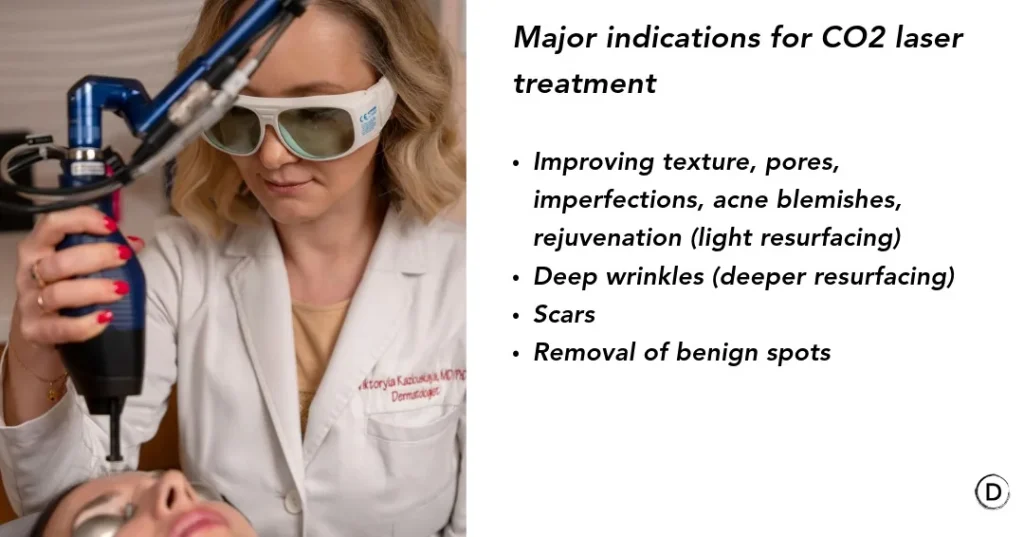
Light Fractional CO2 vs. Deeper CO2 Resurfacing
One of the biggest misconceptions surrounding CO2 laser is that choosing the device tells you what the recovery will be. It does not.
| Factor | Lighter Fractional CO2 | More Aggressive CO2 Resurfacing |
|---|---|---|
| Typical goal | Mild-to-moderate resurfacing | More intensive correction |
| Immediate redness | Expected | Often more pronounced |
| Swelling | Usually less | Can be more significant |
| Peeling / crusting | Generally less extensive | Often more extensive |
| Social downtime | Generally shorter | Generally longer |
| Persistent pinkness | Possible | More likely to persist |
| Treatment selection | Based on skin and goals | Based on skin, goals and tolerance for downtime |
Deeper treatment may be appropriate when more intensive correction is needed. Lighter treatment may make more sense when minimizing downtime is a priority.
At Dermatology Circle in NYC, fractional CO2 resurfacing is one of several skin tightening and resurfacing treatments.
CO2 Laser Risks Worth Understanding
CO2 resurfacing has a long history in dermatology, but it is still a medical procedure with meaningful risks.
- Prolonged erythema;
- Post-inflammatory hyperpigmentation;
- Hypopigmentation;
- Infection;
- Acne or milia;
- Herpes simplex reactivation;
- Delayed healing;
- Persistent sensitivity;
- Scarring.
This does not mean CO2 resurfacing cannot be considered in more pigmented skin. It means patient selection, parameters, indication, and alternative technologies become especially important.
When a Less Aggressive Laser May Make More Sense
Not every patient seeking skin improvement needs deeper CO2 resurfacing.
- Texture;
- Fine lines;
- Mild pigmentation;
- Early photodamage;
- Collagen support.
In that situation, a dermatologist may discuss lighter fractional CO2 treatment or other non-ablative fractional technologies, such as thulium laser. Several staged procedures are also possible.
Less downtime can also mean a different degree of correction.
For patients comparing technologies, our discussion of Sofwave vs. Ultherapy, Fraxel and other energy-based treatments explains why different devices should not be treated as interchangeable.
CO2 resurfacing may also be incorporated into a broader collagen banking strategy when the goal is long-term skin quality rather than a single corrective procedure.
For more pronounced lines, the clinic also discusses CO2 resurfacing among its wrinkle treatment options in NYC.
How We Support You Through CO2 Recovery at Dermatology Circle
Recovery isn’t something we hand you a printout for and send you home — we manage it actively.
Comfort during and right after treatment
Depending on the depth of resurfacing, we use oral pain medication or nitrous oxide (laughing gas) to keep the procedure itself comfortable, and we send patients home with a plan for managing discomfort during the first day or two, when swelling and heat are most noticeable.
Preventing complications before they start
If your history or the treatment area calls for it, we prescribe a prophylactic antibiotic and an antiviral medication in advance. The antiviral may matter even if you’ve never had a cold sore near the treated area, since facial resurfacing can reactivate dormant herpes simplex virus. This is decided during your consultation rather than improvised after the fact.
Guidance through each stage
We walk you through what to expect at each stage of healing before you leave the office, so the peeling, bronzing, or pinkness you see at home matches what you were told to expect rather than triggering unnecessary worry.
Follow-up
We follow up with check-in calls and ensure that the next appointment is scheduled to track progress.
Who Is Actually Managing Your Recovery Matters
CO2 resurfacing is heavily marketed, including by medspas and providers who are not physicians. That matters particularly if recovery moves outside the expected course.
Swelling, peeling, and redness are expected. But worsening pain, spreading redness, signs of infection, a herpes flare, or unusual pigment changes require someone who can assess whether a medical complication is developing and treat it appropriately.
Before booking CO2 resurfacing anywhere, it is worth asking who supervises the procedure, who you will reach if something looks wrong during recovery, and whether that person can prescribe treatment if needed.
The Bottom Line on CO2 Laser Recovery
There is no single “normal” CO2 laser recovery time because CO2 resurfacing is not one fixed procedure.
Lighter fractional treatment may involve substantially less visible recovery than deeper resurfacing. Swelling and redness tend to dominate the early phase, peeling or bronzing may follow, and the surface may heal before residual pinkness completely disappears.
For many patients, the most important question is therefore not:
“How many days does CO2 laser take to heal?”
It is:
“How much treatment do I need, and how much recovery am I realistically willing to accept?”
That decision should be made before the laser settings are chosen.
Considering resurfacing but unsure how much downtime is appropriate for you? Schedule a personalized cosmetic consultation in NYC to compare resurfacing options based on your skin, treatment goals, and schedule.
Frequently Asked Questions About CO2 Laser Recovery
How long is the downtime after fractional CO2 laser?
There is no universal number. Recovery depends heavily on treatment depth, density, area, and individual healing. Deeper treatments generally require more recovery.
What is usually the worst day after CO2 laser?
Many patients find the first 24–48 hours the most noticeable for swelling and redness, while days that follow may look more textured because peeling, bronzing, or crusting begins.
When does peeling start after CO2 laser?
Peeling or surface shedding often becomes more apparent during the first several days after ablative resurfacing. The individual timeline varies.
How long does redness last after CO2 laser?
Pinkness may remain after the skin surface has healed. After deeper resurfacing, redness can sometimes persist for several weeks or longer.
When can I wear makeup after CO2 laser?
Makeup should generally wait until the skin barrier has healed sufficiently and your treating dermatologist says it is appropriate.
Can I go back to work after one week?
Some patients can, particularly after lighter fractional resurfacing, but others may still have visible pinkness or healing after one week.
Can I exercise after CO2 laser?
Your treating dermatologist should provide individualized instructions. Excessive heat, sweating, and strenuous activity may be restricted during the early inflammatory phase.
Is persistent pink skin normal after peeling has stopped?
It can be. Surface healing and complete resolution of inflammation are different processes.
Is deeper CO2 laser always better?
No. Treatment intensity should be selected according to the indication, skin characteristics, desired correction, and how much downtime you can realistically accommodate.
When should I call during recovery?
Contact the treating physician if you develop rapidly worsening pain, spreading or increasing redness after initial improvement, significant drainage, fever, grouped blisters or sores, delayed healing, marked asymmetric swelling, or another change that does not resemble the expected recovery course.