An itchy scalp and increased hair loss can happen at the same time for several completely different reasons.
Sometimes the scalp is inflamed and itchy. Scratching in this case loosens hairs or causes breakage. In other cases, a hair-loss condition is accompanied by inflammation, particularly in scarring alopecias. It is also possible for the itch and hair loss to come from two separate conditions—for example, seborrheic dermatitis occurring in someone who also has androgenetic alopecia.
So when a patient asks, “Why is my scalp itchy and my hair falling out?” I do not start with a shampoo. I start with the scalp.
What does the skin look like? Are there flakes, plaques, pustules, broken hairs or inflammation around individual follicles? Is the hair shedding diffusely or disappearing from specific areas? Are the follicular openings still present?
The important question is not only whether the scalp itches, but why it itches and whether the follicles themselves are at risk.
Can an Itchy Scalp Actually Cause Hair Loss?
Sometimes, but not always. There are several possible relationships between itching and hair loss.
Scratching Can Traumatize and Break Hair
Intense scratching can: loosen hairs that were already close to shedding, break hair shafts, traumatize inflamed scalp skin, lead to infections, and worsen an existing inflammatory condition.
This does not usually mean scratching has permanently destroyed healthy follicles. Usually, when the scalp condition improves, the hair stops breaking or shedding.
Inflammation Can Increase Shedding
Some inflammatory scalp disorders (psoriasis, seborrheic dermatitis, scalp acne) can be associated with increased hair shedding. When the inflammation resolves, the hair may recover if the follicles themselves remain intact.
A Separate Hair-Loss Disorder May Be Present
In some cases, two separate conditions may be present and require different treatments. For example, someone with seborrheic dermatitis or scalp psoriasis may also have female or male pattern hair loss.
In these cases, treating the itching may make the scalp feel much better while the underlying miniaturization and shedding continues.
Inflammation Can Damage the Follicle
This is the “follicle emergency” scenario. In inflammatory scarring alopecias, inflammation targets structures that a follicle needs to continue producing hair. As damage progresses, the follicle may eventually be replaced by scar tissue. Hair lost from a completely destroyed follicle may not regrow.
What Does the Scalp Look Like?
The word itchy tells a dermatologist how the scalp feels. The appearance provides a different layer of information. Several findings can help narrow the possibilities.
Greasy or Flaky Scale
This commonly occurs in seborrheic dermatitis.
Thick or Silvery Scale
More substantial dry plaques with whitish or silvery scale may raise consideration of scalp psoriasis.
Diffuse Redness
Redness can occur with many inflammatory conditions, including seborrheic dermatitis, psoriasis, allergic contact dermatitis and irritant reactions.
Perifollicular Redness or Scale
Perifollicular means surrounding an individual hair follicle. Scale or erythema concentrated directly around follicles can be particularly important when inflammatory alopecia such as lichen planopilaris is being considered.
Pustules
Pus-filled bumps may suggest folliculitis or another infectious/inflammatory follicular disorder.
Broken Hairs
Numerous hairs breaking close to the scalp can occur with several conditions, including fungal infection and mechanical or chemical damage.
Loss of Follicular Openings
A follicular opening is the small visible opening through which a hair emerges. When these openings disappear within an area of hair loss, scarring alopecia becomes an important consideration.
Common Scalp Findings and What They May Suggest
| Scalp Finding | Conditions That May Be Considered | Why It Matters |
|---|---|---|
| Greasy or flaky scale | Seborrheic dermatitis | Common inflammatory cause of scalp itch |
| Thick, dry or silvery scale | Psoriasis | Inflammation, scratching and scale removal can contribute to temporary hair loss |
| Itching after hair dye or a new product | Allergic or irritant contact dermatitis | Product allergy or irritation may be responsible |
| Pustules or tender bumps | Folliculitis or infection | May require targeted evaluation and treatment |
| Scaly patch + broken hairs | Fungal infection | Tinea capitis should be considered |
| Perifollicular scale + burning | LPP or another inflammatory alopecia | May indicate follicular inflammation |
| Smooth shiny scalp / absent follicular openings | Scarring alopecia | Can reflect permanent follicular destruction |
These patterns are educational clues, not a home diagnostic test.
Seborrheic Dermatitis
Seborrheic dermatitis is one of the most common explanations for an itchy, flaky scalp. Typical findings may include: dandruff-like flaking, greasy or dry scale, redness, itching, occasional burning.
It can also involve areas such as the eyebrows, ears, sides of the nose, and mid chest.
Scalp Psoriasis
Psoriasis can also cause an intensely itchy scalp. Typical clues may include: relatively well-defined plaques, thicker scale, whitish or silvery scale, extension beyond the hairline, burning or soreness as well as itching.
Scalp psoriasis can cause temporary hair loss, particularly when the scalp is scratched aggressively or scale is forcibly removed.
Allergic or Irritant Contact Dermatitis
One of the easier diagnoses to overlook is contact dermatitis of the scalp. The scalp is exposed to a surprisingly large number of products (hair dye, shampoo, conditioner, fragrances, preservatives, styling products, oils and scalp treatments, topical medications).
An irritant reaction occurs when a substance damages or irritates the skin directly. An allergic contact dermatitis develops when the immune system has become sensitized to a substance touching the skin.
Dermatitis from a scalp product may also affect the ears, forehead, eyelids and neck. I recently co-authored a review of this underdiagnosed condition in the International Journal of Women’s Dermatology. The article highlighted the potential value of trichoscopy and individualized patch testing when standard testing does not identify the relevant exposure.
What About Topical Minoxidil?
This question comes up frequently because the same patients using minoxidil for thinning hair may also develop scalp symptoms.
If itching, burning, redness or increased scaling begins after topical minoxidil, several possibilities exist:
- Irritant dermatitis;
- Allergic contact dermatitis to minoxidil itself;
- Allergy or irritation from another ingredient in the formulation;
- An unrelated scalp disorder occurring at the same time.
A 2025 systematic review of patch-test-confirmed allergic reactions to topical minoxidil found reactions to both minoxidil itself and formulation ingredients such as propylene glycol.
Scalp Folliculitis
Folliculitis means inflammation involving individual hair follicles. It can look surprisingly similar to an acne breakout on the scalp and is often called “scalp acne.”
When Folliculitis and Hair Loss Need More Attention
Folliculitis decalvans is different from routine transient folliculitis. It is a scarring inflammatory follicular disorder that may produce: recurrent pustules, redness, crusting, grouped or tufted hairs, progressive areas of permanent alopecia.
Fungal Infection of the Scalp
Tinea capitis is a fungal infection involving the scalp and hair. It occurs most commonly in children, but fungal infection remains part of the differential whenever the clinical pattern fits.
Lichen Planopilaris and Other Scarring Alopecias
Scarring alopecia deserves particular attention because the treatment goal is different. In a non-scarring process, the follicle remains structurally capable of producing another hair.
In a scarring alopecia, inflammation damages structures required for continued follicular growth. As the disease progresses, a follicle can eventually be replaced by scar tissue.
Dermatology Circle’s dedicated resource on lichen planopilaris and frontal fibrosing alopecia explains how inflammatory activity and remaining viable follicles influence treatment goals.
Can Scratching Alone Make Hair Fall Out?
Yes, intense or repetitive scratching can contribute to hair loss. But scratching should not become an automatic explanation for progressive thinning.
If hair density continues to decline after the itching is controlled, another process may be occurring.
That could include:
- Androgenetic alopecia;
- Telogen effluvium;
- Inflammatory alopecia;
- Another hair-loss disorder.
Warning Signs That It May Be More Than Dandruff
An itchy scalp does not automatically require an extensive hair-loss workup. But several accompanying findings justify earlier evaluation.
Pay particular attention when itching occurs with:
- Burning;
- Pain or tenderness;
- Pustules;
- Drainage or crusting;
- Focal areas of hair loss;
- Numerous broken hairs;
- Perifollicular scale;
- Redness concentrated around individual follicles;
- Rapidly progressive thinning;
- Eyebrow loss;
- Frontal hairline recession;
- Smooth or shiny areas of scalp;
- Apparent loss of follicular openings.
These findings do not automatically mean scarring alopecia. They mean the scalp deserves a closer examination.
How We Evaluate an Itchy Scalp With Hair Loss
A dermatologist-led hair loss consultation is particularly useful when scalp symptoms and changes in density are occurring together, because the goal is to determine whether the symptom and the hair loss come from the same process or from two simultaneous diagnoses.
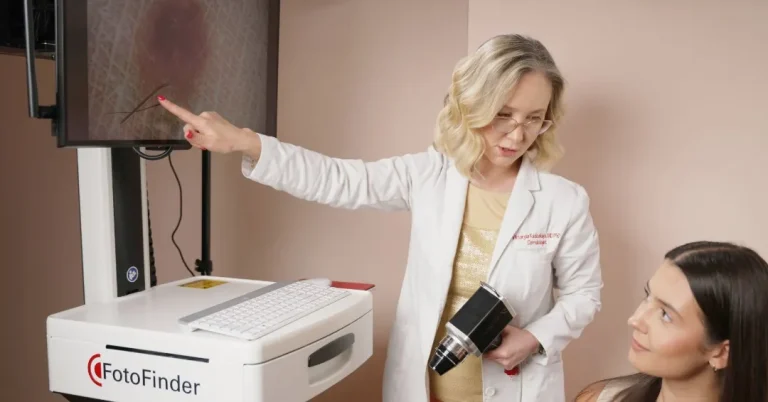
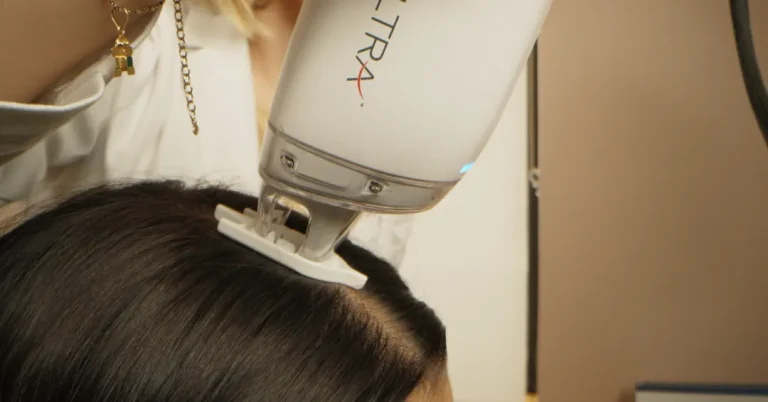
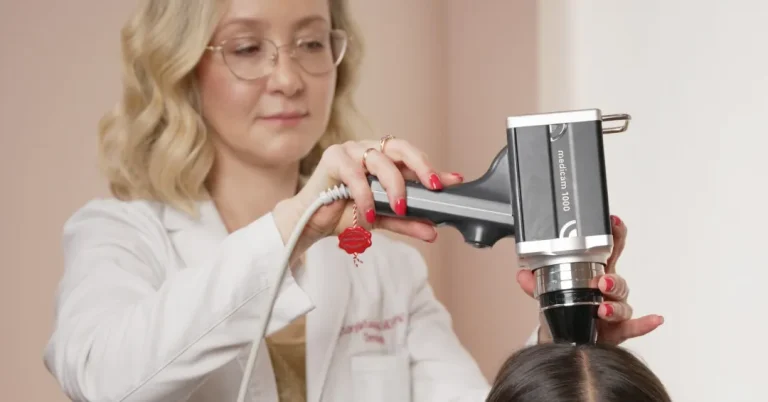
The Role of Trichoscopy
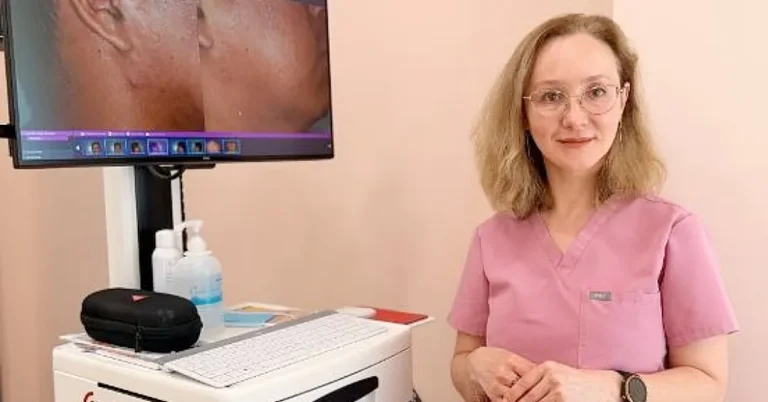
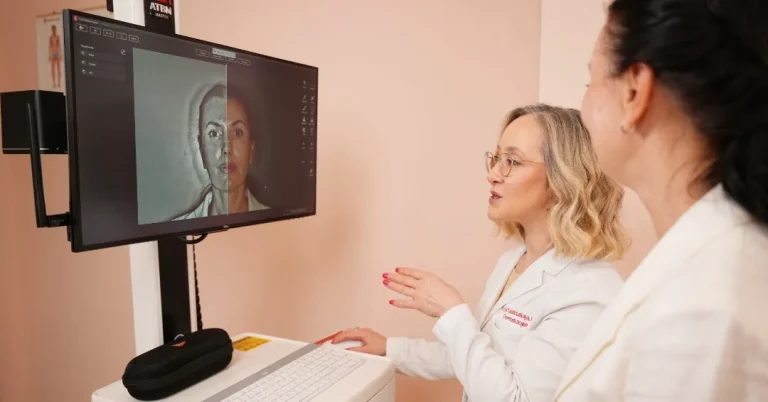
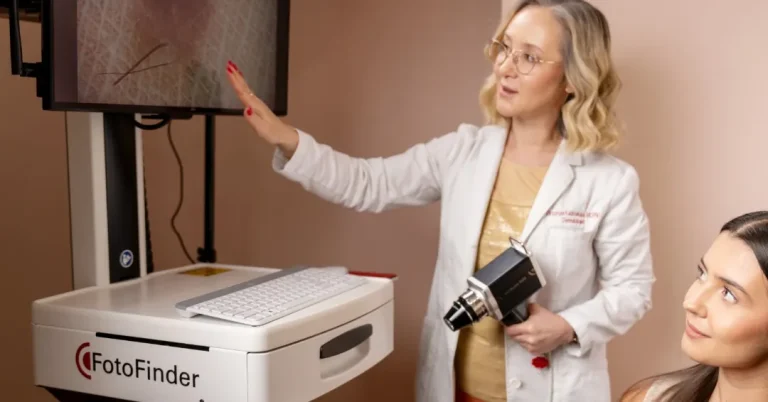
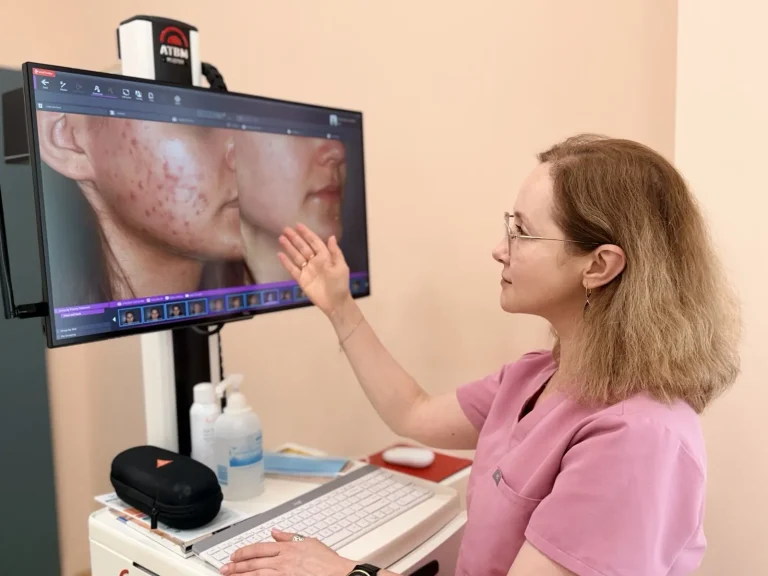
Trichoscopy is a magnified examination of the scalp, hair shafts and follicular structures. It can reveal details that may not be obvious to the naked eye.
Patients can read more about digital trichoscopy and hair-loss diagnosis.
When Is a Scalp Biopsy Needed?
Most people with an itchy scalp do not need a biopsy.
A scalp biopsy becomes more useful when:
- Scarring alopecia is suspected;
- The diagnosis remains uncertain;
- Inflammatory findings persist;
- Progressive loss continues despite apparently appropriate treatment;
- Distinguishing between inflammatory conditions would materially change management.
Biopsy site selection matters. For suspected scarring alopecia, the most useful sample often comes from an area where disease is still active and follicles remain, rather than from the center of an old completely scarred patch. Trichoscopy can help identify such an area.
The microscopic findings are then interpreted alongside the clinical pattern. A biopsy should not be considered a replacement for the examination.
Dermatology Circle’s guide to when a scalp biopsy is needed explains how biopsy adds histopathologic information when inflammatory or scarring hair loss remains a concern.