Choosing between Sculptra and Radiesse should not begin with the question, “Which injectable is better?”
It should begin with the face.
A patient may be noticing diffuse facial deflation, a softer jawline, thinner skin, early laxity, loss of structural support, or several of these changes at the same time. These problems may look related in the mirror, but they are not anatomically identical.
That distinction matters because Sculptra and Radiesse are both collagen biostimulators, but they are not interchangeable materials.
Sculptra is based on poly-L-lactic acid, or PLLA, and is used primarily for gradual tissue remodeling. Radiesse contains calcium hydroxylapatite, or CaHA, suspended in a gel carrier and can provide a meaningful immediate structural component when used in its structural form, followed by longer-term tissue remodeling.
At Dermatology Circle, the more useful sequence is:
- What changed anatomically?
- Is the problem volume, contour, skin quality, laxity—or a combination?
- Is immediate structural correction desirable?
- Would gradual broader remodeling fit the goal better?
- Which material, or another treatment entirely, best matches that anatomy?
The product should follow the anatomy, not the other way around.
What Are Collagen Biostimulators?
Traditional fillers are often discussed in terms of adding volume: material is placed in a specific location to restore support, alter contour or replace volume that has been lost. Biostimulatory injectables add another dimension.
They contain materials that produce a controlled tissue response associated with fibroblast activity, collagen formation and extracellular-matrix remodeling. That is why the term collagen biostimulator is commonly used for products such as Sculptra and Radiesse.
But “stimulates your own collagen” can sound more simplistic than the actual biology. A biostimulator is not simply a natural substance that disappears immediately after injection. Both PLLA and CaHA involve implanted particulate materials that interact with tissue over time. They have product-specific indications, contraindications, expected reactions and procedural risks.
Biostimulation does not mean risk-free, and it does not mean every collagen-stimulating injectable behaves the same way.
PLLA and CaHA both can improve facial volume and skin-quality parameters, while also emphasizing heterogeneity among available studies and the need for better standardized long-term evidence.
How Sculptra Works
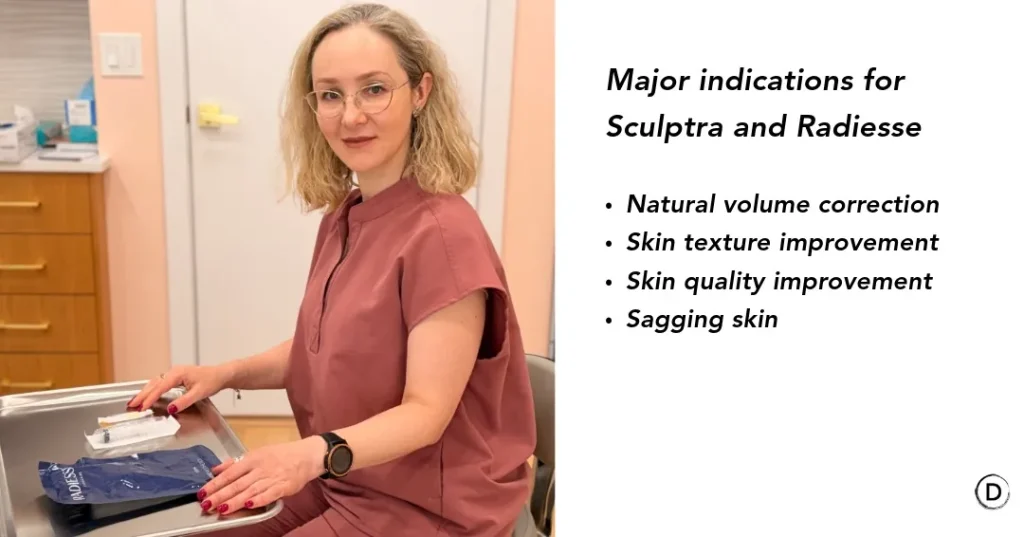
Sculptra contains microscopic particles of poly-L-lactic acid (PLLA), a synthetic biodegradable polymer.
After injection, the particles produce a controlled tissue response. Over time, fibroblast activity and extracellular-matrix remodeling contribute to gradual collagen formation while the PLLA material itself is progressively degraded. It is therefore misleading to describe Sculptra simply as: “a filler that turns into collagen.”
The process is more gradual and biologically complex. The durable aesthetic change does not come simply from filling a space with permanent volume. Instead, the treatment creates progressive tissue remodeling.
This explains why Sculptra is often considered when the aesthetic goal is gradual, broader facial improvement rather than precise immediate correction of one isolated contour defect.
Why Sculptra Can Look Fuller Immediately After Treatment
This point causes considerable confusion. Immediately after a Sculptra treatment, the face may appear fuller. That early fullness is influenced substantially by: the fluid used to reconstitute the product and an injection-related swelling. It is not the final durable Sculptra result.
As the fluid and swelling resolve, some of the apparent correction decreases. Collagen-related improvement then develops gradually over the following weeks and months.
Patients should therefore not judge either success or failure from the appearance immediately after injection.
How Radiesse Works
Radiesse contains calcium hydroxylapatite (CaHA) microspheres suspended in a water-based gel carrier. Its clinical behavior depends considerably on how the product is being used.
When used structurally, the gel and material provide an immediate mechanical correction. This can be useful when the goal includes contour or support. The CaHA microspheres also stimulate longer-term tissue remodeling.
Histologic and mechanistic literature has demonstrated effects involving fibroblast activity, collagen formation, elastin and other extracellular-matrix changes. This makes Radiesse somewhat unusual conceptually: it can provide structure now and biostimulation over time.
When CaHA is diluted and distributed more diffusely for skin-quality goals, its clinical role changes. The patient should not expect the same type of immediate contour correction that would be expected from structural Radiesse.
PLLA vs. CaHA: Why the Materials Matter
Sculptra and Radiesse reach overlapping aesthetic goals through different materials and somewhat different clinical behavior.
Sculptra vs. Radiesse at a Glance
| Feature | Sculptra | Radiesse |
|---|---|---|
| Main material | Poly-L-lactic acid (PLLA) | Calcium hydroxylapatite (CaHA) |
| Treatment concept | Gradual collagen and tissue remodeling | Structural correction + biostimulation depending on use |
| Immediate visible correction | Early fullness is largely fluid/swelling rather than the final result | Can provide genuine immediate correction in structural use |
| Result development | Gradual | Immediate component + progressive remodeling when used structurally |
| Treatment sessions | Frequently staged | Depends heavily on indication and treatment strategy |
| Skin-quality role | Yes | Yes, particularly with selected dilution strategies |
| Contouring role | Can contribute through gradual structural remodeling | Particularly relevant in selected structural applications |
| Hyaluronidase reversible? | No | No |
| Best candidate | Depends on anatomy and treatment goal | Depends on anatomy and treatment goal |
There is deliberately no “winner” column.
Sculptra vs. Radiesse for Facial Volume
Our approach to facial volume loss considers bone-level support, fat compartments, skin quality and laxity separately because a face that looks “deflated” may have changes at several different tissue levels.
Sculptra may be considered when the objective is gradual broader remodeling, particularly when a patient does not want an abrupt visible change. Radiesse may be considered when structural support or more immediate contour correction is part of the goal.
Which Stimulates More Collagen?
This sounds like a straightforward comparison, but current evidence does not justify a universal answer. Both PLLA and CaHA stimulate tissue remodeling.
Their biological pathways overlap in some ways and differ in others. Recent reviews describe distinct inflammatory, fibroblast and extracellular-matrix responses with the various biostimulatory materials. To learn more about other ways to stimulate collagen, see our blog article on collagen banking.
Is Radiesse a Filler or a Biostimulator?
It can function as both, depending on how it is being used. In structural applications, Radiesse can provide: immediate support, volume or contour correction, a subsequent biostimulatory response.
When CaHA is diluted for selected skin-quality applications, the mechanical volumizing role becomes much less important and the treatment becomes more focused on distributed tissue remodeling.
This is why seeing the word “Radiesse” on two treatment plans does not necessarily mean the same procedure is being performed.
Structural vs. Diluted or Hyperdiluted Radiesse
Patients increasingly encounter the term hyperdiluted Radiesse online. The concept deserves clarification. Adding diluent changes how the material behaves and how diffusely it can be distributed.
In selected situations, diluted CaHA is used primarily for skin quality and biostimulation rather than conventional volume creation.
As of 2026, FDA approval specifically includes Radiesse Injectable Implant diluted 1:2 with sterile saline for correction of décolleté wrinkles in patients 22 and older. Because this is now a separate FDA-approved diluted Radiesse indication, we discuss it in detail in our dedicated article on Radiesse for the décolletage.
Which Treatment Requires More Sessions?
Sculptra is commonly approached as a staged treatment rather than a one-time correction. Current FDA patient labeling describes a Sculptra treatment regimen of up to four sessions, generally separated by several weeks. That is product-label information, not a statement that every patient needs four treatments.
A treatment requiring fewer sessions is not automatically better. For a patient who wants a very gradual change, staged treatment may actually be desirable.
How Quickly Do Results Develop?
Sculptra
Durable improvement is gradual. The early fluid-related fullness subsides and tissue remodeling develops over subsequent weeks and months.
Radiesse
Structural Radiesse can provide an immediate component, followed by continued tissue remodeling. Diluted CaHA used primarily for skin quality should not be judged according to the same immediate-volume expectations. This difference is one reason the patient’s desired timeline matters during treatment selection.
How Long Can Results Last?
This is another area where simple online comparisons become misleading. Both PLLA and CaHA have demonstrated durable aesthetic effects in clinical studies.
PLLA effects may extend beyond two years in some studies and CaHA outcomes extend beyond a year in included studies.
Can Sculptra and Radiesse Be Combined?
Sometimes. But combination treatment should not be interpreted as physically mixing products or as evidence that every patient needs both.
Different treatment goals can reasonably lead to different modalities across different areas or at different points in time. Another patient may need only one treatment.
Complementary does not mean interchangeable, and it does not mean more treatment is automatically better.
Sculptra and Radiesse vs. Hyaluronic Acid Filler
Hyaluronic acid fillers remain extremely useful because they solve a different set of problems. HA fillers are especially useful when the objective is: immediate correction, precise focal volume, contour, adjustability.
They also have an important practical distinction: HA can often be enzymatically dissolved with hyaluronidase if clinically necessary.
PLLA and CaHA
Sculptra and Radiesse create longer-term tissue responses and are not simply dissolved with hyaluronidase. This does not mean HA is inferior or biostimulators are “more natural.” They are different tools.
The dermal filler options used at Dermatology Circle include HA, PLLA and CaHA because no single injectable solves every structural problem.
Can Biostimulators Replace Skin-Tightening Devices?
Not necessarily. Volume loss and laxity can look similar from the outside. They are not the same anatomical problem. Injectable biostimulation works through an injected material and tissue response.
Skin-tightening technologies use energy to create controlled remodeling at selected tissue depths. A patient whose main issue is loss of structural volume may benefit more from an injectable. A patient with adequate volume but early dermal laxity may be better suited to a treatment such as Sofwave skin tightening or another tightening modality. Some patients benefit from both approaches at different times.
A practice offering multiple technologies has an advantage only if those treatments are actually selected according to the anatomy rather than routinely stacked together.
Real Patient Case: Combination Facial Rejuvenation
This case illustrates how Sculptra can be incorporated into a broader facial-rejuvenation plan when a patient has more than one anatomical concern. It is not a direct comparison between Sculptra and Radiesse, and it should not be interpreted as evidence that every patient needs the same combination of treatments.
Two-Year Facial Rejuvenation With Sculptra and Complementary Treatments
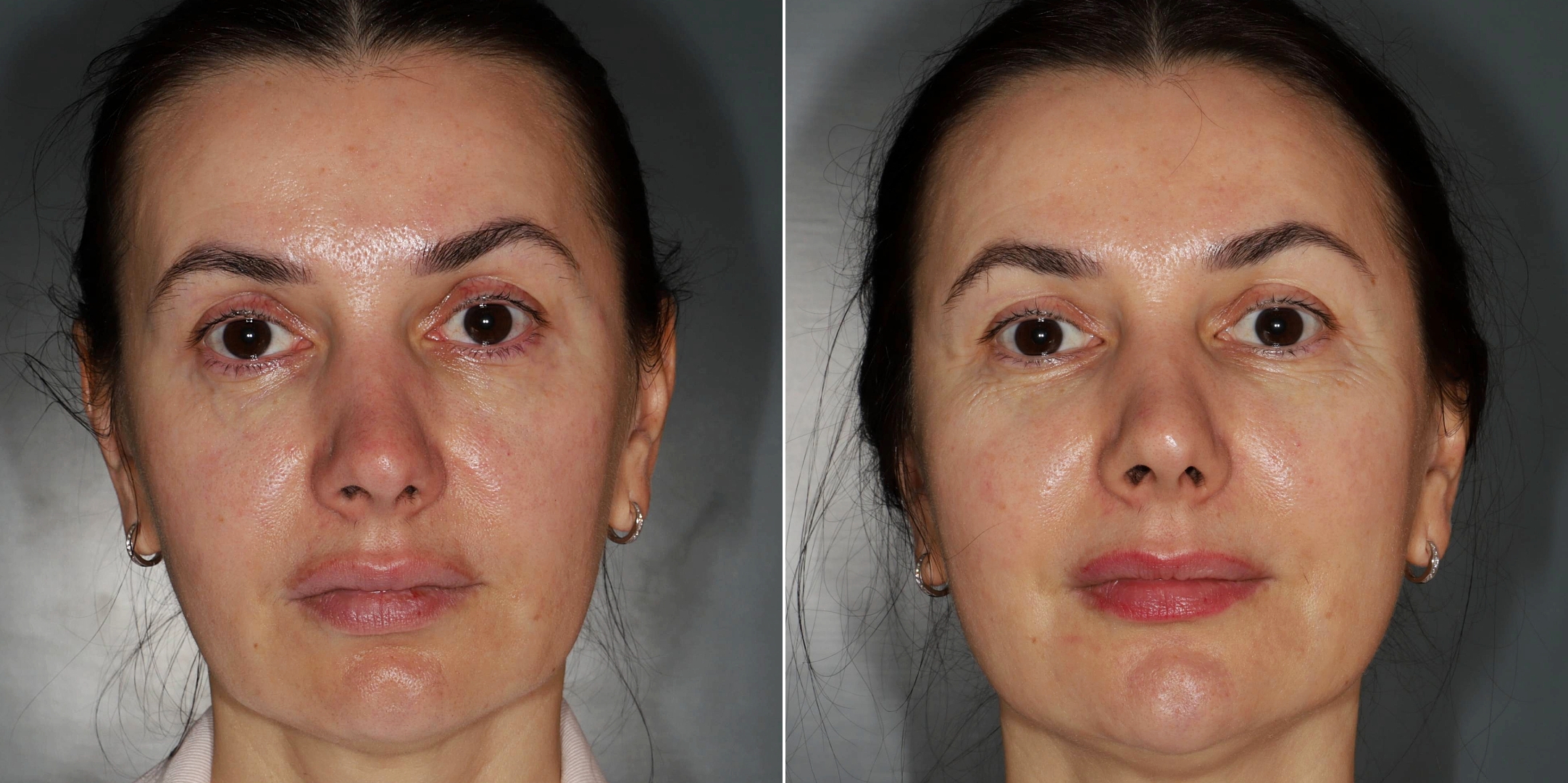
This transformation developed over two years through a personalized protocol designed to restore youthful volume, refine skin texture and maintain natural facial harmony. The plan included Sofwave for tightening and lifting, Sculptra for gradual collagen stimulation and structural support, Botox for fine-line softening, Skinvive for hydration, gentle fractional laser resurfacing for pores and texture, and strategic filler placement in the cheeks and temples.
Why “Non-Reversible” Matters
Hyaluronic acid filler has a practical safety and correction tool: hyaluronidase can often dissolve HA. Neither PLLA nor CaHA can simply be erased in the same way.
Calling biostimulators “non-reversible” does not mean every unwanted effect is permanent or unmanageable. It means the management strategy is different.
That makes several things particularly important:
- Conservative planning;
- Appropriate product selection;
- Facial anatomy;
- Treatment sequencing;
- Avoiding unnecessary correction.
When a product cannot simply be dissolved, thoughtful treatment before injection becomes even more valuable.
Sculptra and Radiesse: Dermatology Circle Approach
None of this is meant to help you diagnose yourself online and walk in asking for a specific product by name.
The comparisons above explain why Sculptra and Radiesse differ, but they cannot tell you which anatomical problem you actually have, or whether either product is the right answer at all. That determination requires a hands-on facial assessment: evaluating volume loss, skin quality, laxity and bony support together, not matching symptoms to a product description found online.
And sometimes the correct answer is neither Sculptra nor Radiesse.
If you are considering Sculptra, Radiesse or another approach to facial rejuvenation, schedule a cosmetic consultation at Dermatology Circle so we can evaluate your facial anatomy, skin quality, volume loss and laxity together before choosing an injectable.