A cluster of small bumps around the mouth can look exactly like an acne breakout and is not always easy to distinguish.
Both conditions can produce red or skin-colored papules and even small pustules. The more useful clues are often elsewhere: where the eruption occurs, whether blackheads or whiteheads are present, whether the surrounding skin burns or flakes, and what medications or skincare products were being used before it started.
Perioral dermatitis is the term most patients know, but the term periorificial dermatitis is medically more accurate because the eruption can develop not only around the mouth but also around the nose and eyes.
The diagnosis matters because treatments that make sense for acne can be unnecessarily irritating when the eruption is actually perioral dermatitis.
Why Perioral Dermatitis Is Often Mistaken for Acne
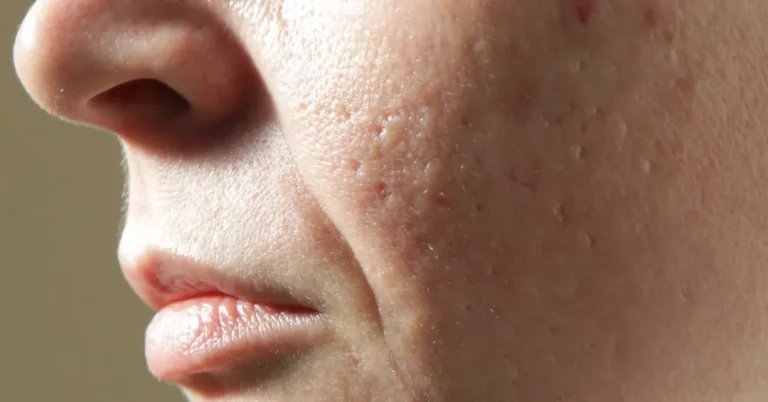
At first glance, the two conditions can look remarkably similar. Both may produce small inflammatory bumps, red or skin-colored papules, pustules, or clusters of lesions on the lower face.
Looking at one bump in isolation may therefore tell you very little. A dermatologist looks at the pattern.
That includes assessing:
- Where the lesions are concentrated;
- Whether they all look relatively similar;
- Whether comedones are present;
- Whether there is background scale or dryness;
- Whether the skin burns or stings;
- Whether lesions occur elsewhere on the face, chest, or back;
- Whether topical corticosteroids have been used;
- What skincare products preceded the eruption.
The location of a breakout can sometimes be as informative as the appearance of an individual bump. But location alone is not enough. Acne can absolutely occur around the mouth and chin, which is why the rest of the pattern matters.
Where Each Condition Usually Appears
Perioral Dermatitis
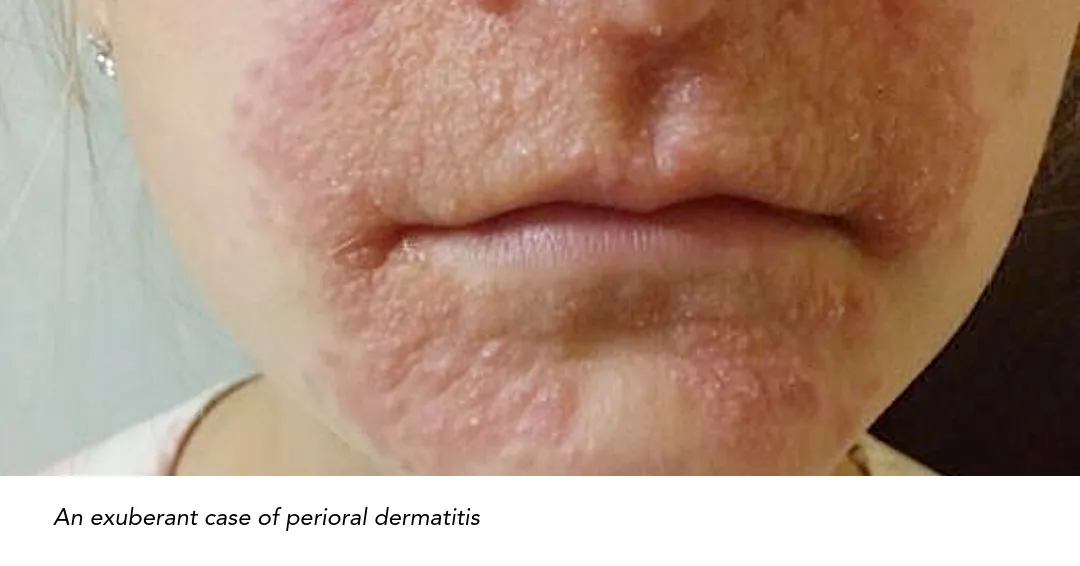
Perioral dermatitis most classically clusters around the lower face. It may involve the area around the mouth, chin, nasolabial folds, or sides of the nose. The eruption can also occur around the eyes or nose, which explains the broader term periorificial dermatitis.
Some patients have a narrow strip of relatively unaffected skin immediately next to the lip border. Dermatologists sometimes use this as a clinical clue, but it is not an absolute requirement for the diagnosis. The condition is fairly common in children.
Acne
Acne has a broader distribution that may include the trunk, tends to have comedones (whiteheads or blackheads), and may result in scarring. Patients with true acne can review physician-directed acne treatment in NYC, but the diagnosis should come before simply escalating acne therapy.
Perioral Dermatitis vs. Acne: Key Differences
| Feature | Perioral Dermatitis | Acne |
|---|---|---|
| Typical lesions | Small papules and sometimes pustules | Comedones, papules, pustules, nodules or cysts |
| Blackheads | Generally not typical | Common |
| Whiteheads / closed comedones | Generally not typical | Common |
| Distribution | Often around mouth, nose and/or eyes | Can affect multiple facial areas, chest and back |
| Dryness / flaking | Common | May occur but is not a defining feature |
| Burning / stinging | Can occur | Less characteristic |
| Topical steroid association | Important potential trigger | Not a typical acne driver |
| Skincare irritation | May contribute | Can aggravate acne through different mechanisms |
| Scarring | Not typical in usual disease | Possible, especially with inflammatory acne |
| Treatment | Dermatitis-specific treatment | Acne-directed therapy |
This table can help organize the differences, but it cannot diagnose an individual eruption.
Does Perioral Dermatitis Burn, Itch or Flake?
It can. Perioral dermatitis may be associated with burning, stinging, itching, tightness, dryness, and fine scaling.
Not every patient experiences these symptoms. Some have very little discomfort and mainly notice the bumps. Acne can also become dry or irritated, particularly when retinoids, benzoyl peroxide, acids, or other active treatments are being used.
But a background of burning, sensitivity and fine scaling surrounding many small similar papules may encourage a dermatologist to think beyond ordinary acne.
Can Skincare Products Trigger Perioral Dermatitis?
The exact cause of perioral dermatitis is still not completely understood. Current dermatology literature describes a combination of potential influences, including triggering exposures, skin-barrier dysfunction, inflammation and possible microbiome changes.
For some patients, the eruption appears after a change in their skincare routine.
Potential contributors may include:
- Irritating skincare;
- Heavy or occlusive facial products;
- Multiple layered cosmetics;
- Certain sunscreens;
- Oral-care products in selected patients;
- Repeated disruption of the skin barrier.
This does not mean moisturizer causes perioral dermatitis. It does not mean sunscreen should be permanently stopped. Sometimes the problem is not one specific ingredient but the cumulative effect of too many products on already reactive skin.
Can Over-Treating the Skin Make the Rash Worse?
This happens frequently. Repeated exfoliation and irritation can disrupt the skin barrier and make the entire area appear more inflamed.
The Role of Topical Steroids
Topical corticosteroid exposure is one of the most important historical clues in perioral dermatitis. Patients sometimes begin applying a steroid because the area is red, itchy, and irritated.
Initially, the response may look excellent. But then the rash returns. The steroid is applied again. It improves again, and another flare follows later. This can create a frustrating cycle.
Temporary improvement with a steroid does not necessarily mean the steroid is treating the underlying problem. Prolonged facial use of topical corticosteroids is strongly associated with perioral dermatitis, and repeated exposure can make the clinical course more difficult.
Rosacea vs. Perioral Dermatitis
Perioral dermatitis and rosacea can overlap visually. Perioral dermatitis more often emphasizes a periorificial pattern around the mouth, nose and/or eyes.
There is not always a perfectly sharp boundary between facial inflammatory disorders, and steroid exposure can make the appearance even more confusing.
Dermatology Circle’s rosacea and facial redness evaluation also emphasizes diagnosis before selecting treatment because rosacea, acne, dermatitis and other facial conditions can resemble one another.
What About Hormonal Acne Around the Chin and Jawline?
Adult acne, especially in women, often affects the lower face. So “pimples around the chin” do not automatically mean perioral dermatitis.
But the morphology is usually still acne. Depending on the patient, there still may be: closed comedones, blackheads, inflammatory papules, or deeper nodules.
A patient can also have more than one diagnosis. For example, someone may have established acne along the jawline and later develop a separate perioral dermatitis eruption closer to the mouth after repeated steroid or skincare exposure. That is another reason diagnosis from location alone is unreliable.
Other Conditions That Can Look Similar
Facial bumps are a pattern, not a diagnosis.
Other conditions that may sometimes resemble acne or perioral dermatitis include:
- Rosacea;
- Seborrheic dermatitis;
- Allergic contact dermatitis;
- Irritant contact dermatitis;
- Folliculitis;
- Steroid-induced rosacea-like dermatitis;
- Other inflammatory facial eruptions.
This does not mean a patient needs to research every possible diagnosis. It explains why persistent facial eruptions sometimes need examination rather than another round of trial-and-error skincare.
How Dermatologists Diagnose Perioral Dermatitis
Perioral dermatitis is usually a clinical diagnosis. In many cases, no biopsy, blood test or culture is necessary. A dermatologist evaluates several pieces of information together.
Often, the most valuable diagnostic tool is a careful history plus examination of the pattern.
Patients with an unclear persistent facial eruption can start with a medical dermatology consultation rather than continuing to add products without knowing what is being treated.
Perioral Dermatitis Treatment Approaches
Treatment depends on the individual presentation.
Addressing Contributing Steroid Exposure
If topical corticosteroids appear to be contributing, their use needs to be reconsidered appropriately. Prescription medications should be changed under medical guidance rather than through a universal internet taper.
Simplifying Skincare
In some patients, temporarily reducing the number of products helps decrease repeated irritation.
Topical Medication
Depending on the patient, dermatologist-directed options may include prescription medications such as:
- Topical metronidazole;
- Topical erythromycin;
- Other selected anti-inflammatory therapies.
The exact treatment depends on the clinical circumstances.
Oral Treatment
More persistent or extensive disease may sometimes be treated with an oral tetracycline-class medication such as doxycycline in an appropriate patient. This should not be interpreted as a universal prescription or dosing recommendation. Treatment choice changes with age, pregnancy status, severity and other medical factors.
Why Are Antibiotics Used if Perioral Dermatitis Is Not Simply an Infection?
The word “antibiotic” can create the impression that perioral dermatitis must be caused by bacteria. That is not the case here.
Tetracycline-class medications such as doxycycline have anti-inflammatory effects in addition to their antimicrobial activity. Dermatologists use that property in several inflammatory skin disorders.
How Long Does Perioral Dermatitis Take to Clear?
Improvement is usually gradual. For some patients, meaningful improvement takes several weeks. More persistent eruptions may take longer.
Patients who have been repeatedly using topical corticosteroids may initially experience rebound worsening, which can make the early phase feel as though treatment is failing. This is one reason repeatedly changing treatments every few days can be counterproductive. Skin needs enough time for the inflammatory pattern to settle.
Does Perioral Dermatitis Leave Scars?
Typical perioral dermatitis generally does not behave like severe inflammatory acne when it comes to permanent atrophic scarring. That can be reassuring.
However, after the active eruption improves, some patients may temporarily have: lingering redness, pigment alteration, and sensitivity. Picking, squeezing and aggressive attempts to exfoliate the eruption can make the recovery less predictable.
Acne is different because significant inflammatory acne, particularly deeper nodules and cysts, can produce permanent scars.
What to Bring to the Appointment
A surprisingly useful part of the appointment is knowing exactly what has been touching the skin. Consider bringing, or photographing, the products you use. Also bring photographs if the eruption looked different earlier.
Steroids and other treatments may temporarily change morphology, so an earlier image can sometimes provide useful context.
Perioral Dermatitis vs. Acne: The Bottom Line
If an acne-like rash around the mouth, nose or eyes is not improving, or becomes more irritated with acne products, schedule a medical dermatology evaluation at Dermatology Circle to determine whether the eruption represents acne, perioral dermatitis, rosacea or another inflammatory facial condition.