Many patients are searching for CO2 laser resurfacing as one of the most aggressive and effective treatments for acne scars, but it may not be the optimal treatment for everyone. A fractional CO2 laser can improve texture and remodel scarred skin, but it cannot mechanically release every scar that is anchored downward. Similarly, subcision can release selected fibrous attachments beneath a depressed scar, but it does not resurface the entire face.
Therefore, the more useful question is not: “What is the best acne-scar treatment?”
“What type of scar is being treated, and what is creating that depression?”
What to Expect: Improvement, Not Erasure
Before discussing scar types and procedures, it is important to set realistic expectations. Acne scars can be meaningfully improved in depth, contour, sharp edges, texture, shadowing, and overall visibility. But no responsible treatment plan should promise perfectly smooth, scar-free skin.
Reviews of laser treatment in skin of color similarly emphasize that acne scars can improve substantially but are not eliminated by any treatment. The realistic goal is to make scars shallower, softer, and less visually dominant, but not to erase every sign that acne ever occurred.
Medical management also plays a central role, not just procedural treatment. Preventing the next scar generally matters more than resurfacing an old one while new inflammatory lesions continue to develop. Patients with active acne may first need prescription topical treatment, hormonal therapy where appropriate, oral medication, or isotretinoin in selected cases before or alongside individualized scar-focused treatment.
Aggressive scar correction without controlling significant ongoing inflammatory acne can become a cycle of treating existing scars while new ones continue to form.
With that framing in mind, the first step in any scar treatment plan is identifying what type of scar is actually present.
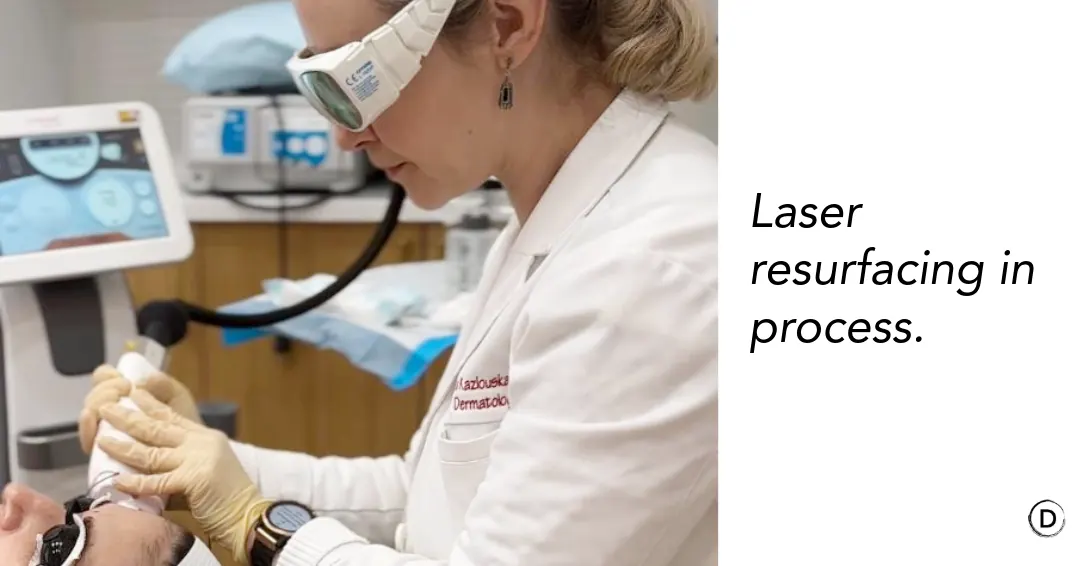
Why Identifying the Type of Acne Scar Matters
Two scars that can look nearly identical in the mirror may actually be structurally very different, and telling them apart is exactly where a dermatologist’s expertise matters. What looks like a simple depression or bump to the naked eye often behaves differently once the skin is stretched, palpated, or examined under directional light, and each scar type responds best to a different treatment approach.
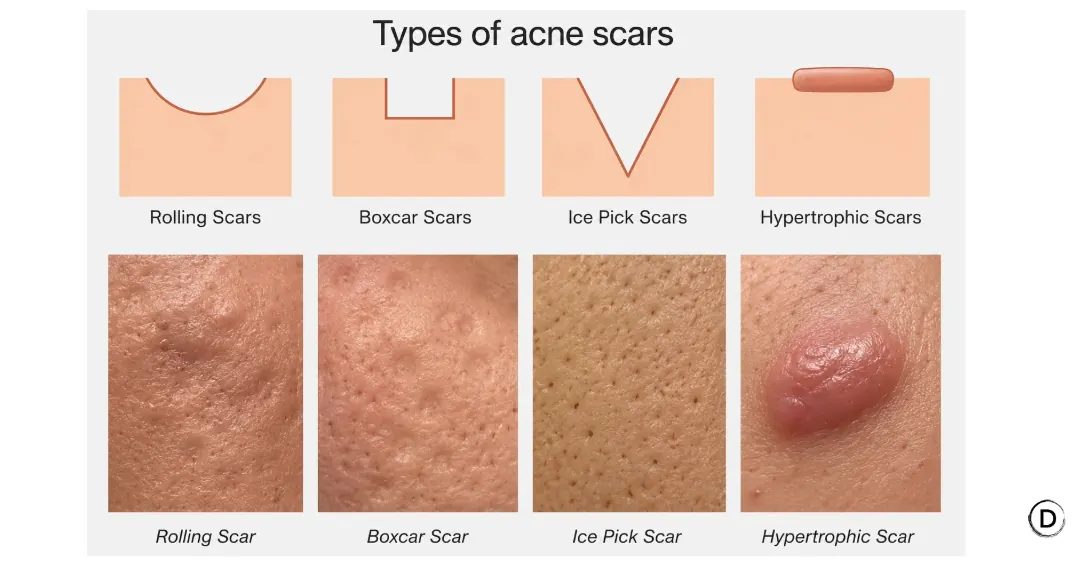
Acne scars generally fall into a few distinct categories:
Atrophic scars, meaning that the scar sits below the level of the surrounding skin.
- Rolling scars: broad, shallow depressions with soft, sloping edges that create a wave-like unevenness in the skin;
- Boxcar scars: round or oval depressions with sharper, more clearly defined edges;
- Ice-pick scars: narrow at the surface but extending deep into the skin, like a small puncture.
Hypertrophic scars are raised, firm scars that sit above the surrounding skin. They are caused by excess collagen production during healing, unlike the other three types, which are depressed.
This classification is clinically useful because the shape visible on the surface often gives clues about what is happening below it.
During an acne-scar assessment and a thorough cosmetic consultation, a dermatologist may evaluate width, depth and shape of the edges; underlying fibrosis; distribution; skin thickness; associated pigmentation or redness; active acne; skin tone; and the tendency toward post-inflammatory hyperpigmentation.
A person described as having “pitted acne scars” may actually have a mixture of shallow boxcar scars, tethered rolling scars, and a few deep ice-pick scars.
| Scar Type | Typical Appearance | Main Structural Issue | Treatments That May Be Considered |
|---|---|---|---|
| Rolling | Broad, wave-like depressions with sloping edges | Dermal change; some are tethered by fibrous bands | Subcision, potentially adding fillers, combination techniques |
| Boxcar | Round or oval depressions with more defined edges | Dermal tissue loss and defined scar borders | Fractional CO2, microneedling, selected focal excision or punch techniques |
| Ice-pick | Narrow opening extending deeply into the skin | Deep focal scar tract | TCA CROSS or selected punch techniques |
| Hypertrophic | Firm elevated nodules | Excessive collagen tissue or keloid | Intralesional steroids, vascular lasers, CO2 laser, or excision |
| Mixed scars | Several patterns on the same face | Multiple mechanisms | Staged or combination treatment |
This table is a framework rather than a prescription. For patients considering future acne scar treatment options in NYC, identifying the scar morphology should come before selecting a procedure.
Rolling Acne Scars
Rolling scars usually create broader, shallow-to-moderate depressions with soft, sloping edges. Instead of looking like individual holes, they may produce a wave-like unevenness across the cheek.
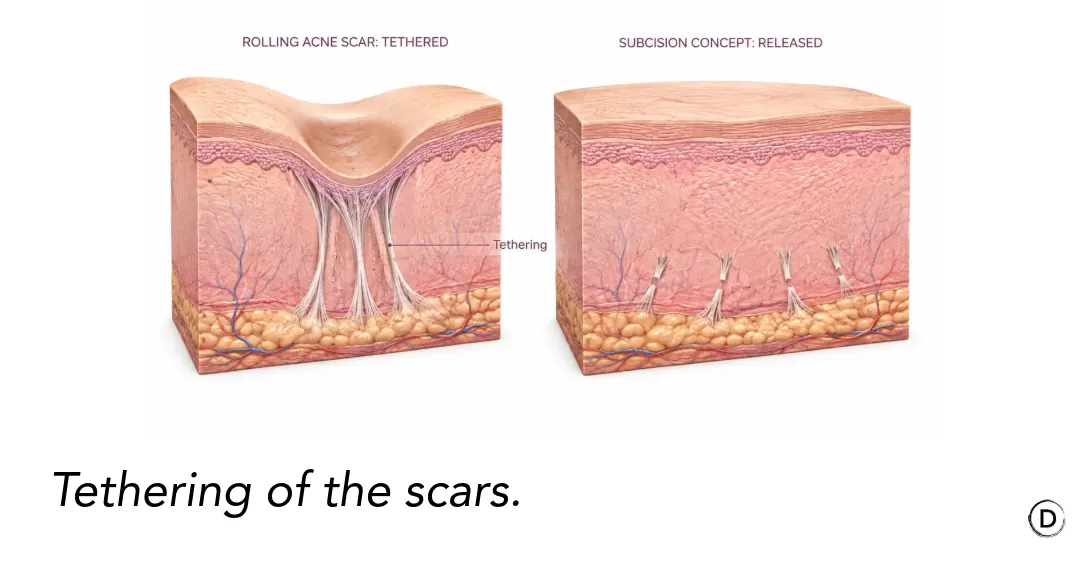
They can also become much more visible when light comes from the side. One important feature of these scars is tethering. This means the skin is being pulled downward from underneath by a fibrous band of scar tissue that has formed beneath the surface, anchoring that spot of skin to deeper tissue. Think of it like a small thread stitched from the surface down to the tissue below; it holds that point of skin lower than the skin around it, which is what creates the depression you see.
Some rolling scars are anchored downward by fibrous bands beneath the skin. When those attachments pull the skin toward deeper tissue, treating only the surface may improve texture without completely correcting the depression.
If part of the scar is being held down from below, resurfacing the top does not necessarily remove the force pulling it downward.
This is where subcision may become relevant.
However, not every rolling scar is significantly tethered. Some may respond to microneedling or fractional resurfacing, while others benefit from a sequence involving release of tethering followed by resurfacing or another remodeling procedure.
Boxcar Scars
Boxcar scars generally appear as round or oval depressions with more sharply defined edges than rolling scars. They vary considerably in depth.
A shallow boxcar scar may respond reasonably well to a treatment that remodels the surface and softens its borders.
A deep boxcar scar behaves differently. If the scar extends substantially into the dermis with steep walls, repeated global resurfacing alone may produce only partial improvement.
Depending on morphology, treatment may include:
- Fractional CO2 resurfacing;
- Microneedling;
- Adding volume with hyaluronic acid filler or biostimulatory injectables such as Sculptra or Radiesse;
- Punch elevation or excision in appropriate scars;
- Combination approaches.
Ice-Pick Scars
Ice-pick scars can look deceptively small. They typically have a narrow surface opening but extend more deeply into the skin. Because the deepest portion of the scar may be much narrower and deeper than the visible opening, treating the entire face at a superficial or moderate depth may not adequately address the tract.
This is why focal treatments are often considered.
Options may include:
- TCA CROSS, a physician-performed focal chemical reconstruction technique;
- Punch excision in selected scars.
Published studies and reviews support the use of TCA CROSS, particularly for selected ice-pick scars. This is not a home-treatment technique. High-strength acids used for focal scar treatment can cause burns, pigment changes and scarring if applied incorrectly.
The broader clinical principle is what matters: A narrow, deep scar may require a focal treatment rather than repeatedly treating the entire facial surface.
Post-Acne Redness and Pigmentation Are Not Necessarily Scars
Patients often use the term “acne scars” to describe anything that remains after a breakout. But a flat mark is not necessarily a structural scar. There are various clinical presentations of post-acne.
Post-Inflammatory Erythema
Post-inflammatory erythema, or PIE, appears as flat red or pink discoloration after inflammation. This type of spot can be treated with VBeam (PDL laser) or other types of vascular lasers.
Post-Inflammatory Hyperpigmentation
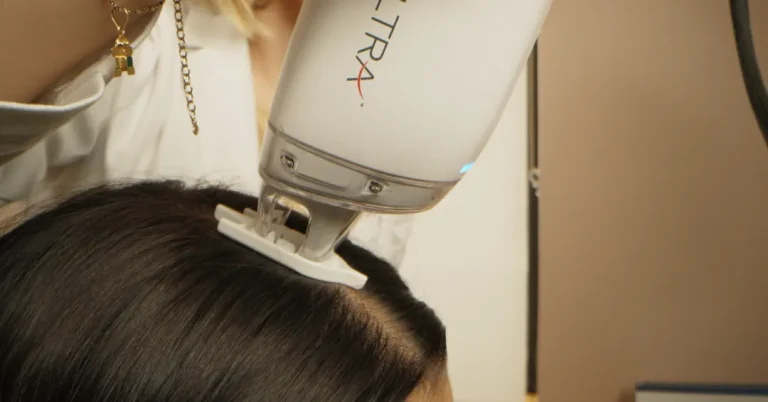
Post-inflammatory hyperpigmentation, or PIH, appears as flat brown, gray, or darker areas after acne. PIH may respond to chemical peels and resurfacing lasers, often ones with less downtime, such as the thulium laser (Ultra LaseMD, Lutronic).
Where Subcision Fits
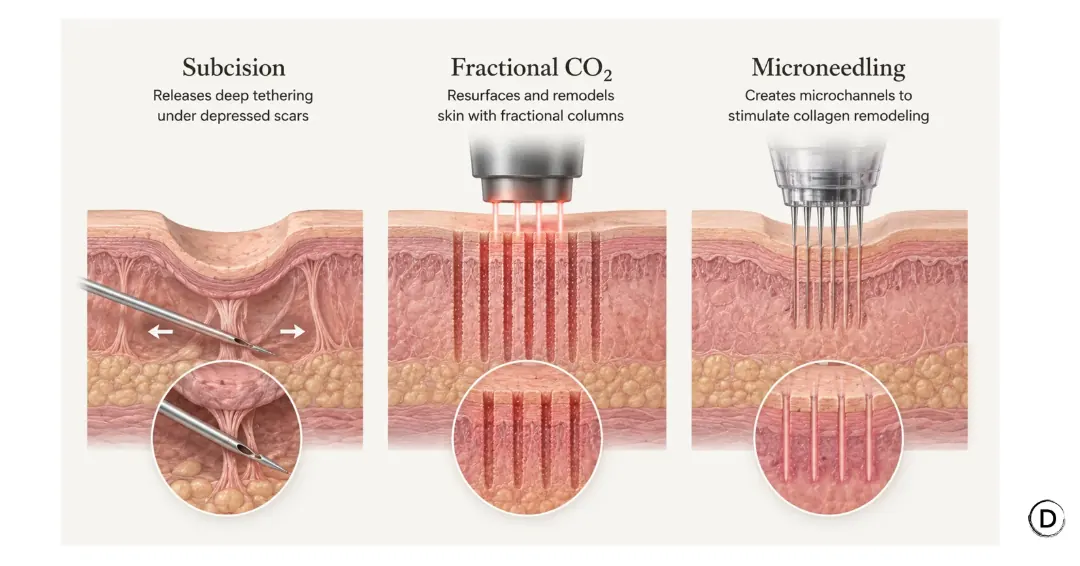
Subcision is a procedure designed primarily to release selected fibrous attachments beneath depressed scars. Its conceptual role is straightforward: Subcision addresses tethering.
It is most commonly considered for selected rolling or depressed scars in which fibrous bands contribute to the contour defect. It does not globally resurface the skin, remove pigmentation, or treat every acne scar on the face.
Expected temporary effects may include:
- Bruising;
- Swelling;
- Tenderness;
- Hematoma formation.
Clinical trials also support the logic of combining subcision with other modalities rather than assuming release alone will address every component of mixed atrophic scarring. In one randomized study, subcision combined with fractional CO2 produced greater improvement than subcision alone.
Where Fractional CO2 Resurfacing Fits
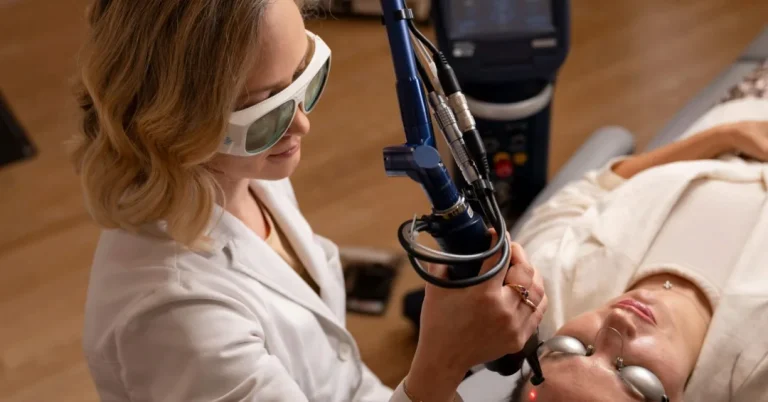
Fractional CO2 is an ablative fractional resurfacing treatment. Instead of removing the entire surface uniformly, fractional treatment creates microscopic treatment columns separated by untreated tissue. This stimulates wound healing and dermal remodeling while allowing surrounding tissue to support recovery.
Potential roles in acne scarring include:
- Improving broader surface irregularity;
- Softening selected boxcar scar edges;
- Improving selected rolling scars;
- Collagen remodeling;
- Blending transitions between scarred and surrounding skin.
At Dermatology Circle, CO2 is one of several skin resurfacing and tightening treatments used according to skin type, treatment goal, and acceptable recovery.
The key limitation is important: Fractional CO2 remodels scarred tissue, but it does not mechanically release every tethered scar.
Someone with significant rolling-scar tethering may therefore benefit more from addressing the tethering before or alongside broader resurfacing.
CO2 also involves trade-offs. Greater treatment intensity can mean:
- More swelling and redness;
- Longer recovery;
- More persistent post-treatment erythema;
- Increased concern about post-inflammatory hyperpigmentation in susceptible skin.
Where Microneedling Fits
Microneedling creates controlled mechanical micro-injuries that activate a wound-healing response and stimulate collagen remodeling. It can be useful for selected atrophic acne scars and has the practical advantage of comparatively limited surface injury.
Potential advantages include:
- Relatively modest downtime;
- Gradual improvement;
- Usefulness in selected rolling and boxcar scars;
- Applicability across a broad range of skin tones when appropriately performed.
Dermatology Circle uses physician-selected microneedling treatments for acne scars and other textural concerns.
Its limitations are just as important. Microneedling generally requires a series of treatments. It does not mechanically release a tethered scar, and deep ice-pick scars are unlikely to be adequately addressed by needling alone.
A recent comparison of fractional CO2 and microneedling found improvement with both treatments, with stronger scar improvement from CO2 but a different side-effect and downtime profile.
Microneedling therefore should not be described as “CO2 without downtime.” They produce tissue remodeling through different mechanisms and are not interchangeable procedures.
CO2 vs. Subcision vs. Microneedling: What Is the Difference?
Patients often compare these treatments as if they were three versions of the same procedure. They are not.
Subcision
Primary conceptual target: fibrous tethering beneath selected depressed scars.
Fractional CO2
Primary conceptual target: surface irregularity and dermal remodeling.
Microneedling
Primary conceptual target: controlled collagen remodeling with relatively limited downtime.
| Treatment | Primary Target | Often Considered For | Main Limitation |
|---|---|---|---|
| Subcision | Fibrous tethering | Selected rolling and tethered depressed scars | Does not globally resurface skin |
| Fractional CO2 | Texture and dermal remodeling | Selected boxcar or rolling scars and broader textural change | Downtime and pigment considerations |
| Microneedling | Collagen remodeling | Selected atrophic scars | May be insufficient for deep or strongly tethered scars |
| Focal treatments | Individual deep scars | Selected ice-pick or deep boxcar scars | Do not address broader facial texture |
The treatments can therefore be complementary. A patient may need subcision because a scar is tethered, followed later by fractional resurfacing because the surface contour remains irregular.
Another patient may have shallow scars that do not require subcision at all.
Acne Scar Treatment Results
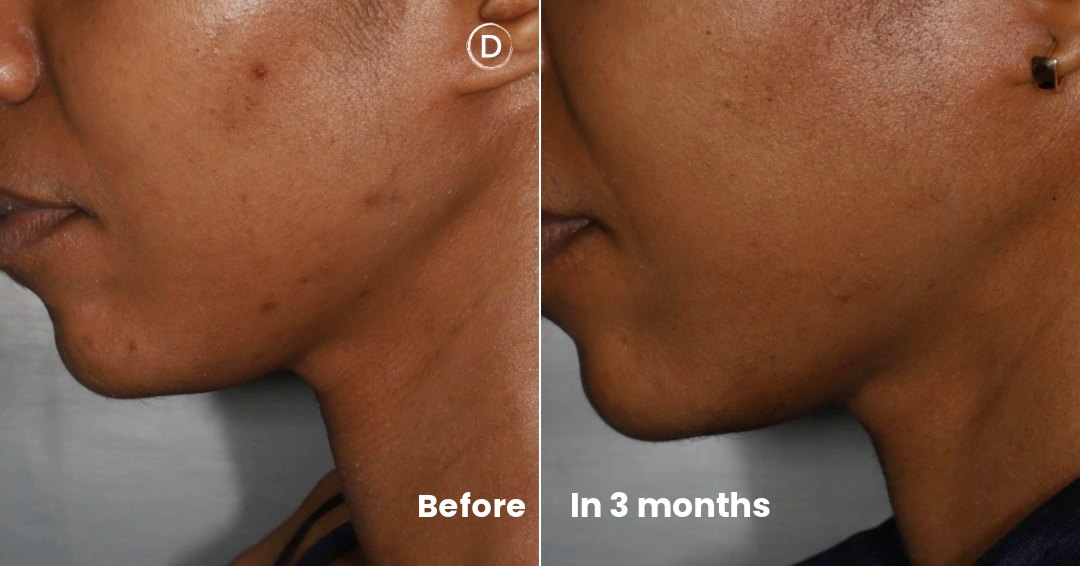
Post-Acne Texture & Pigmentation Improvement
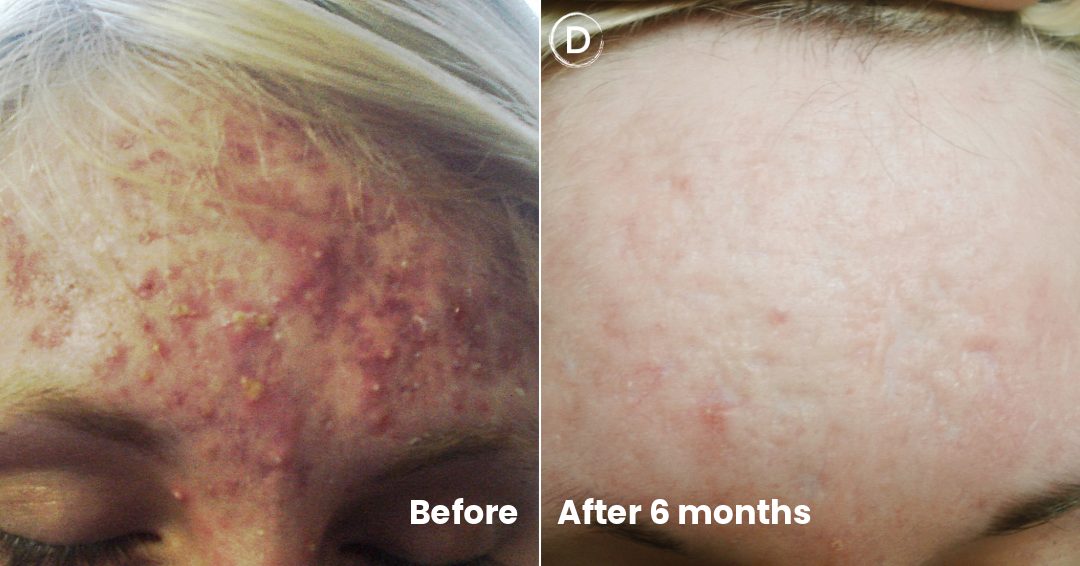
From Severe Acne to Clearer Skin
Why Combination Treatment Is Often Used
Mixed acne scarring is common. An illustrative treatment sequence might look like:
- Control active acne.
- Release selected tethered scars.
- Add fillers if needed to prevent tissue loss and support collagen under the released scar.
- Treat individual deep focal scars.
- Improve broader texture and scar edges.
- Address remaining redness or pigmentation separately.
This is an example of clinical reasoning, not a protocol that should be followed for every patient.
Combination treatment does not mean using every procedure available. It means matching each component of the scar to the treatment designed to address it.
Combination strategies are supported by clinical literature because different modalities address different structural aspects of atrophic scarring.
Acne Scars and Darker Skin Tones: Pigment Considerations
Darker skin tones can absolutely be treated for acne scarring. The treatment plan simply needs to account for melanin and a patient’s tendency to develop post-inflammatory hyperpigmentation after procedures.
Patients with more pigmented skin have a greater tendency toward PIH after inflammatory or energy-based procedures, but appropriately selected laser treatment can still be performed safely.
The appropriate conclusion is therefore not: “CO2 cannot be used in darker skin.”
The balance between scar remodeling and pigment risk requires more careful selection of technology, parameters, and treatment sequence.
Sometimes microneedling or another modality may provide a better risk-benefit balance. In other patients, fractional laser can still be appropriate.
How Many Acne Scar Treatments Might Be Needed?
There is no useful universal number.
The number of sessions depends on:
- Scar morphology;
- Scar depth;
- Number of scars;
- Degree of tethering;
- Treatment modality;
- Skin type;
- Treatment intensity;
- Previous procedures;
- Individual healing;
- Acceptable downtime;
- Desired degree of improvement.
A staged plan may also make “number of treatments” the wrong question. For example, one patient may have a subcision session, focal treatment for several deep scars, followed by resurfacing. Another may undergo a series of microneedling sessions alone.
Both are acne-scar treatment plans, but counting the number of sessions does not capture what each procedure is trying to accomplish.
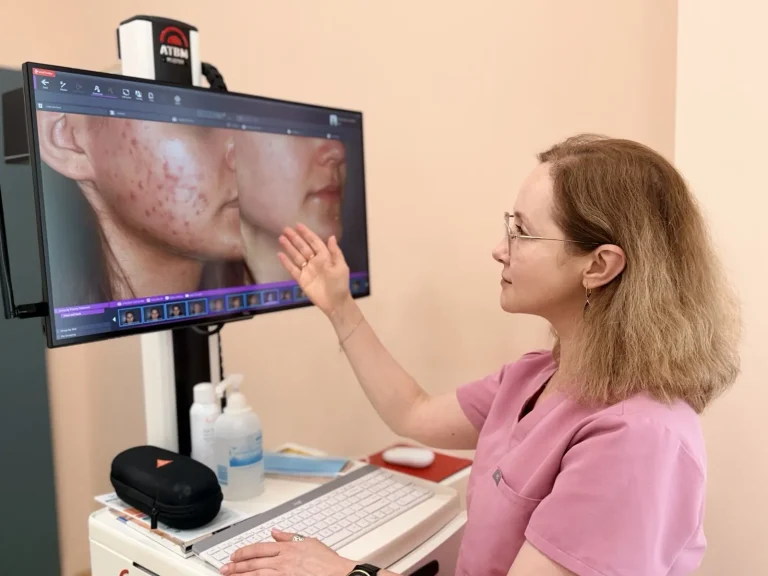
Why Lighting and Scar Mapping Matter
Acne scars rarely look identical in every photograph.
Front-facing soft lighting can make significant scars look surprisingly subtle. Directional or oblique light casts shadows across depressions and often reveals rolling and boxcar scars much more clearly.
For this reason, scar assessment may involve looking at the face:
- Directly from the front;
- From each side;
- Under overhead or directional lighting;
- With the skin relaxed;
- While gently changing skin tension.
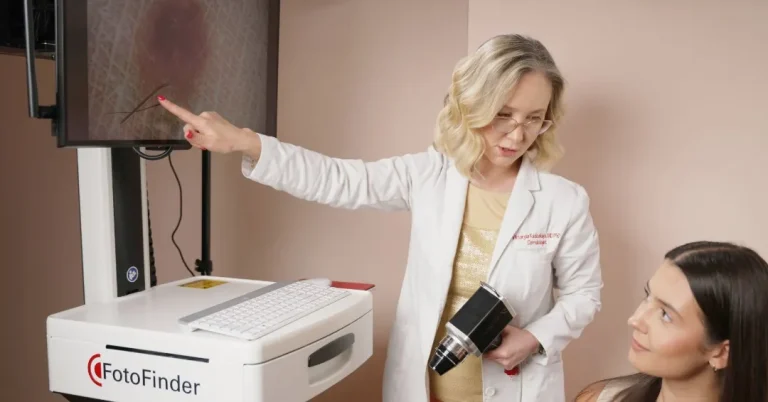
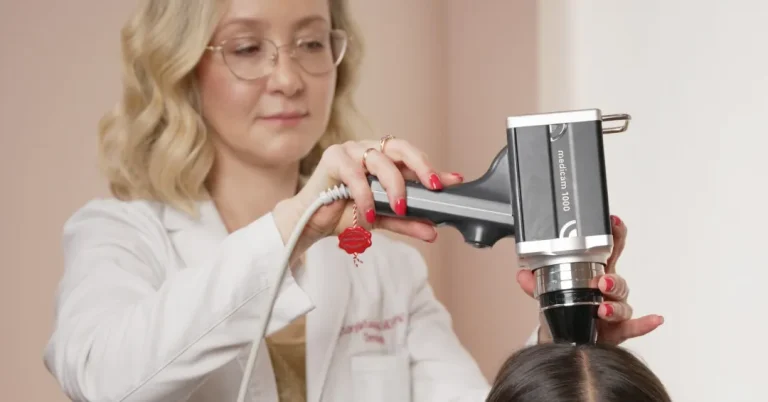
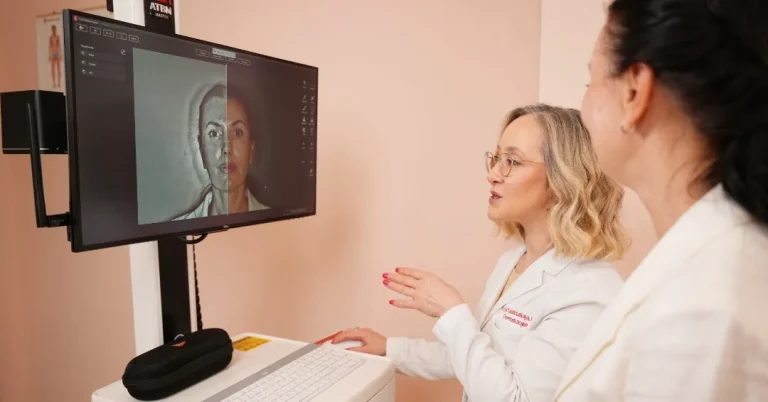
Photography from several angles can also help document which areas actually change over time. This is especially useful when determining whether a depression is predominantly a surface contour issue or whether deeper tethering may be involved.
How I Build an Acne-Scar Treatment Plan at Dermatology Circle
When I evaluate a patient for acne scarring, I am looking at far more than “rolling vs. boxcar vs. ice-pick.” I assess depth, scar edges, tethering, distribution across the face, whether acne is still active, redness, pigmentation, skin tone, history of PIH, prior procedures, downtime tolerance, personal goals, and budget. All of it factors into the plan.
In my experience, no single scar and no single face responds to just one device. I combine treatments deliberately, targeting each area of the face with whatever will be most effective for what is actually there.
One thing I want patients to know: dermal fillers and biostimulators are, in my view, underutilized for boxcar and rolling scars. They are often overlooked in favor of lasers and needling, but for the right scar, adding volume back, whether temporarily with HA filler or gradually with a biostimulator, can make a meaningful difference, and I use them more than most practices do.
As a board-certified dermatologist and dermatopathologist, I also treat the full picture medically, not just cosmetically: controlling active acne, managing pigmentation, and choosing laser settings appropriate to the patient’s actual skin type. I work with a full range of laser technology suited to both darker and lighter skin tones, because using the wrong settings for a patient’s skin is one of the most common ways acne-scar treatment goes wrong.
This is also why a personalized cosmetic consultation matters more than picking a procedure off a list. The best acne-scar plan is built around your scars, your skin, and what will actually work together, not around one device.