Hair shedding during weight loss can be alarming, especially when it begins months after starting a medication such as Ozempic, Wegovy, Zepbound, or Mounjaro. It can feel especially frustrating when you’re finally seeing the benefits — better metabolism, weight loss, overall well-being — and hair loss shows up anyway.
The term “Ozempic hair loss: or “GLP-1 hair loss”, however, can oversimplify what is happening.
Current dermatology guidance acknowledges reports of hair thinning during GLP-1 treatment while emphasizing that the exact mechanism is not fully established. This means hair loss should not automatically be interpreted as direct damage to the hair follicles from the medication itself.
The most useful question is often not simply, “Is my GLP-1 causing hair loss?” but rather:
What type of hair loss is occurring, and could more than one process be happening at the same time?
Most explanations for GLP-1-related shedding focus on weight loss as an indirect trigger. But recent systematic reviews suggest the picture may be more layered than a single downstream effect.
A 2026 systematic review of pharmacovigilance data and clinical cohorts found that semaglutide and tirzepatide carry the highest reported incidence of hair loss among GLP-1 receptor agonists, with more frequent signal detection than other drugs in the class. Androgenetic alopecia and telogen effluvium were identified as the two predominant subtypes, and tirzepatide (associated with the greatest magnitude of weight loss) was most frequently linked specifically to telogen effluvium. A separate systematic review reached similar conclusions and included alopecia areata among the hair-loss subtypes being investigated in this population, reflecting that autoimmune alopecia is also part of the differential being studied.
Do GLP-1 Medications Actually Cause Hair Loss?
Yes, hair loss has been reported during treatment with GLP-1-based medications, but several mechanisms may additionally contribute.
Rapid weight loss
Significant weight loss is a physiological change. Similar to what can happen after surgery, illness, childbirth, or severe dietary restriction, it may disrupt the normal hair-growth cycle and trigger temporary shedding.
Reduced food intake
GLP-1 medications often decrease appetite substantially. Some patients begin consuming significantly fewer calories and may unintentionally reduce their intake of protein, iron, and other nutrients important for normal hair growth.
Nutritional or medical factors
Iron deficiency, thyroid abnormalities, inadequate protein intake, and other nutritional or metabolic issues may contribute to shedding. These factors may have existed before GLP-1 treatment or become more relevant during substantial weight loss.
Pre-existing pattern hair loss
Not every patient with Ozempic hair loss, Wegovy hair loss, or Zepbound hair loss has telogen effluvium alone.
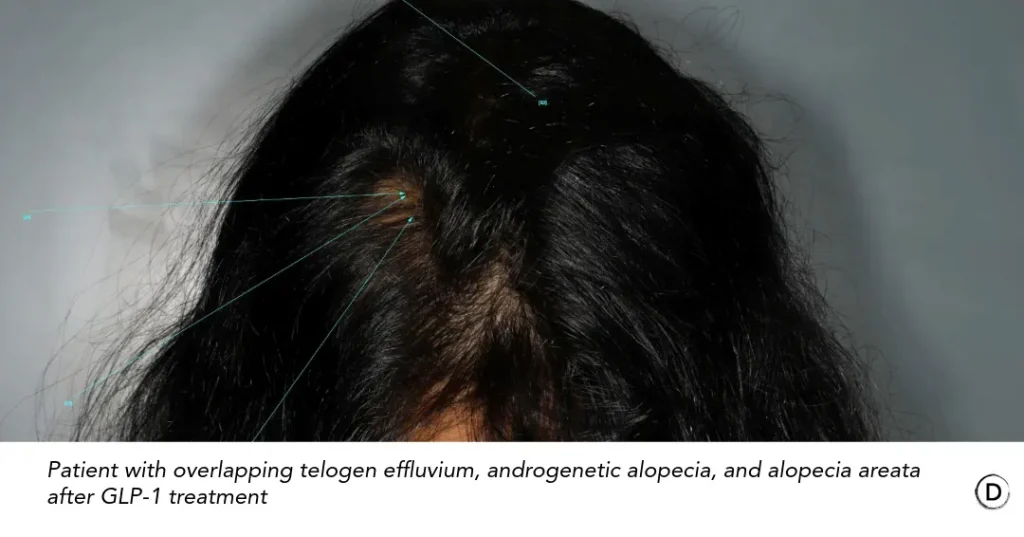
Female or male pattern hair loss may have been developing gradually for years. A period of intense shedding can suddenly make that underlying thinning much more visible. There are also cases of alopecia areata associated with GLP-1 inhibitors.
For this reason, the appearance of hair loss during GLP-1 treatment does not by itself establish the diagnosis.
Why Rapid Weight Loss Can Trigger Telogen Effluvium
Hair follicles continuously move through cycles of growth, transition, rest, and shedding.
Most scalp hairs are normally in the active growth phase, called anagen. After a significant physiological stressor, more follicles than usual may enter the resting, or telogen, phase.
Those hairs do not fall immediately. They remain in place for a period of time before being shed.
This delayed shedding is known as telogen effluvium.
Common triggers include:
- rapid or substantial weight loss;
- significant calorie restriction;
- low protein intake;
- iron deficiency;
- illness or fever;
- surgery;
- major physiological or emotional stress;
- thyroid abnormalities;
- certain medications.
Several triggers can occur together.
For example, a patient taking a GLP-1 medication may be losing weight rapidly while also eating less protein and having low iron stores. In this situation, identifying one single cause may not accurately reflect what is happening.
You can read more about the condition on our telogen effluvium page.
When Does GLP-1-Related Hair Shedding Usually Appear?
Telogen effluvium generally does not begin immediately after the triggering event.
Because affected follicles must first transition through the hair cycle, noticeable shedding often develops approximately two to three months after a major physiological change.
With GLP-1 treatment, the timeline may be less precise because weight loss can continue over many months.
A typical pattern may be:
- Weight loss or another physiological trigger begins.
- Some follicles shift from the growth phase into the resting phase.
- Increased shedding appears several weeks or months later.
- Shedding gradually improves once the trigger stabilizes.
- New hairs begin growing, but visible density takes longer to return.
The last point is important.
Less shedding does not immediately mean full density. New hairs must grow long enough to contribute visibly to overall volume, so recovery is usually gradual.
Telogen Effluvium vs. Female or Male Pattern Hair Loss
Distinguishing telogen effluvium from androgenetic alopecia is one of the most important parts of evaluating hair loss after weight loss.
In telogen effluvium, the main problem is a temporary disruption of the hair cycle.
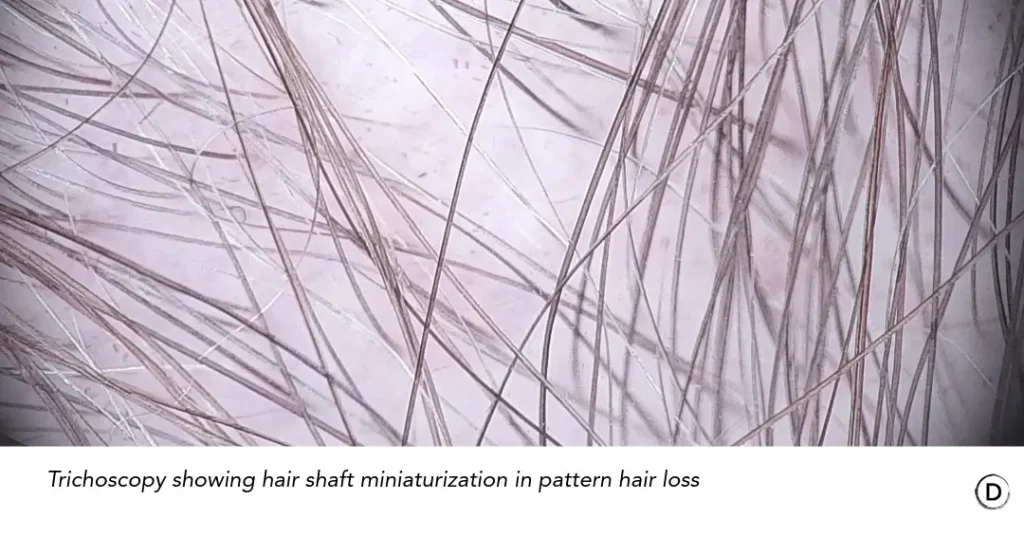
In androgenetic alopecia, also called female or male pattern hair loss, susceptible follicles gradually produce thinner and shorter hairs. This process is called follicular miniaturization.
| Feature | Telogen Effluvium | Pattern Hair Loss |
| Typical onset | Often follows a trigger | Usually gradual |
| Main symptom | Increased shedding | Progressive thinning |
| Distribution | Usually diffuse | Often patterned or regionally predominant |
| Follicular miniaturization | Usually absent | Present |
| Widening of the part | May occur as density decreases | Common in female pattern hair loss |
| Spontaneous recovery | Often possible when trigger resolves | Usually requires ongoing management |
| Trichoscopy useful? | Yes | Yes |
| Can both coexist? | Yes | Yes |
The last row is particularly important.
A patient may have temporary telogen effluvium and underlying androgenetic alopecia at the same time.
That distinction affects both prognosis and treatment.
If the problem is isolated telogen effluvium, correcting the trigger and allowing the hair cycle to recover may be sufficient. If pattern hair loss is also present, waiting for the shedding to stop may leave the underlying progressive condition untreated.
For more information about conditions that commonly affect women, see hair loss types that impact women more.
Why GLP-1 Treatment May Reveal Hair Loss That Was Already Developing
Pattern hair loss often develops slowly.
Early in the process, individual follicles begin producing finer hairs, while the overall hairstyle may still look relatively full. A patient can therefore have measurable follicular miniaturization without realizing that hair loss has started.
Then a shedding episode occurs.
When overall density suddenly decreases, previously subtle changes become easier to see. The center part may look wider, the frontal scalp may become more visible, or the ponytail may feel thinner.
This can create the impression that weight loss caused an entirely new permanent hair-loss disorder.
In some patients, however, temporary shedding has simply unmasked pattern hair loss that was already developing.
This is one reason why persistent thinning should not automatically be attributed to telogen effluvium.
More information is available on our androgenetic alopecia page.
When Blood Tests or Nutritional Evaluation Are Useful
Laboratory testing is not necessary for every patient with GLP-1-associated shedding.
Testing should be guided by the medical history, examination, diet, amount and speed of weight loss, and associated symptoms.
Depending on the situation, a dermatologist may consider:
- complete blood count;
- iron studies and ferritin;
- thyroid function;
- vitamin B12;
- vitamin D;
- zinc;
- other testing based on individual history.
Protein intake and overall nutritional adequacy may also be important, particularly when appetite has decreased substantially.
The goal is not to test every possible vitamin level or automatically recommend supplements. Instead, evaluation should identify clinically meaningful deficiencies or medical conditions when they are suspected.
Taking multiple hair supplements without confirming a deficiency may not address the actual cause of hair loss.
How Dermatologists Diagnose Hair Shedding With Trichoscopy
The diagnosis begins with the timeline.
A dermatologist may ask about:
- when GLP-1 treatment was started;
- dose changes;
- how quickly weight was lost;
- changes in diet or protein intake;
- illnesses or surgery;
- other medications;
- previous episodes of shedding;
- family history of pattern hair loss;
- when excessive shedding actually began.
The scalp examination then helps determine whether the loss appears diffuse, patterned, inflammatory, patchy, or potentially scarring.
Why digital trichoscopy can be especially useful
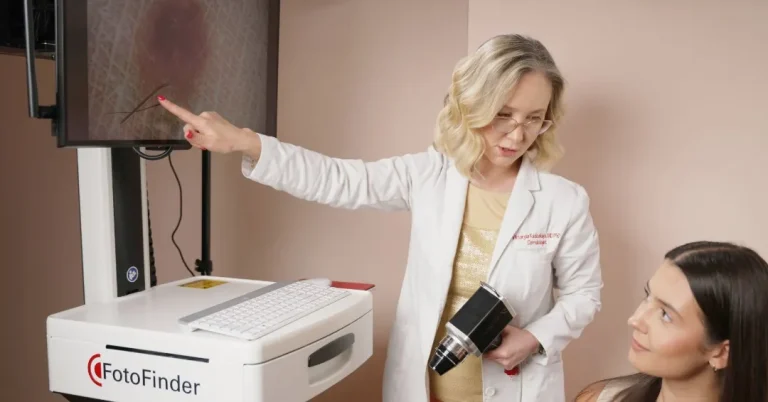
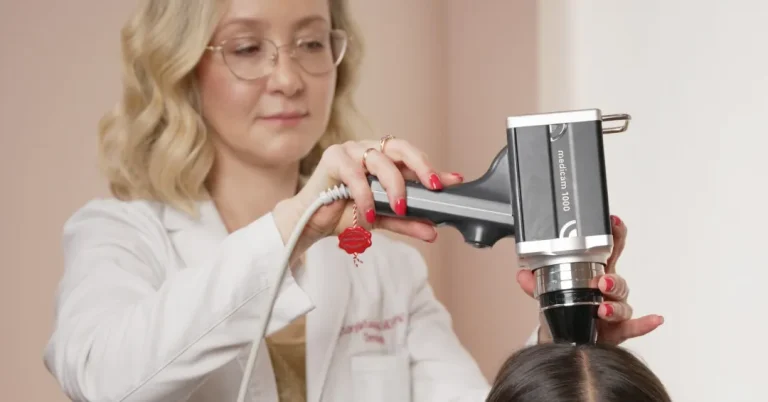
Trichoscopy is a magnified examination of the scalp and hair follicles.
It may help identify:
- differences in hair shaft thickness;
- follicular miniaturization;
- the proportion of finer hairs;
- regional differences across the scalp;
- signs of regrowth;
- inflammation or scaling.
This is particularly useful when the clinical question is whether a patient has temporary shedding alone or shedding combined with pattern hair loss.
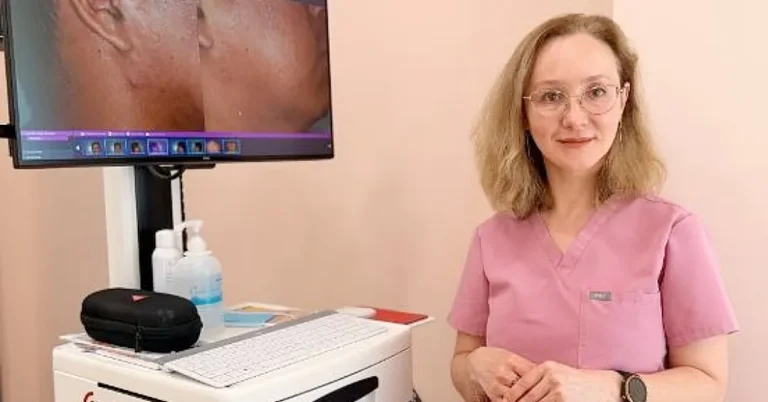
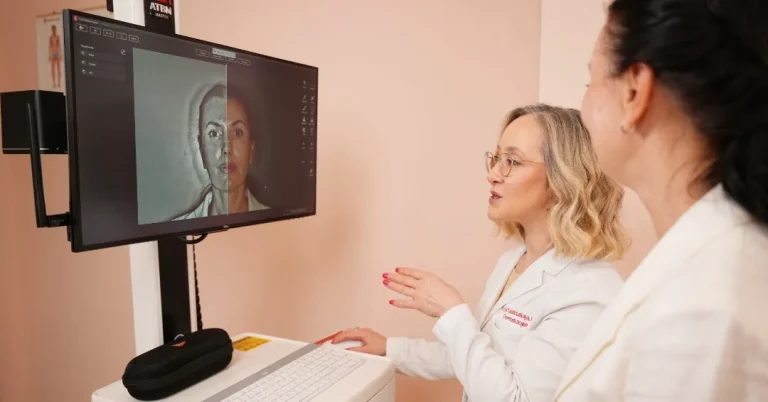
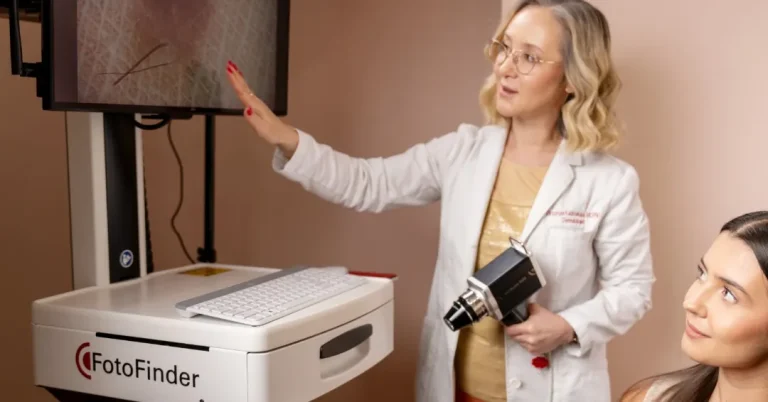
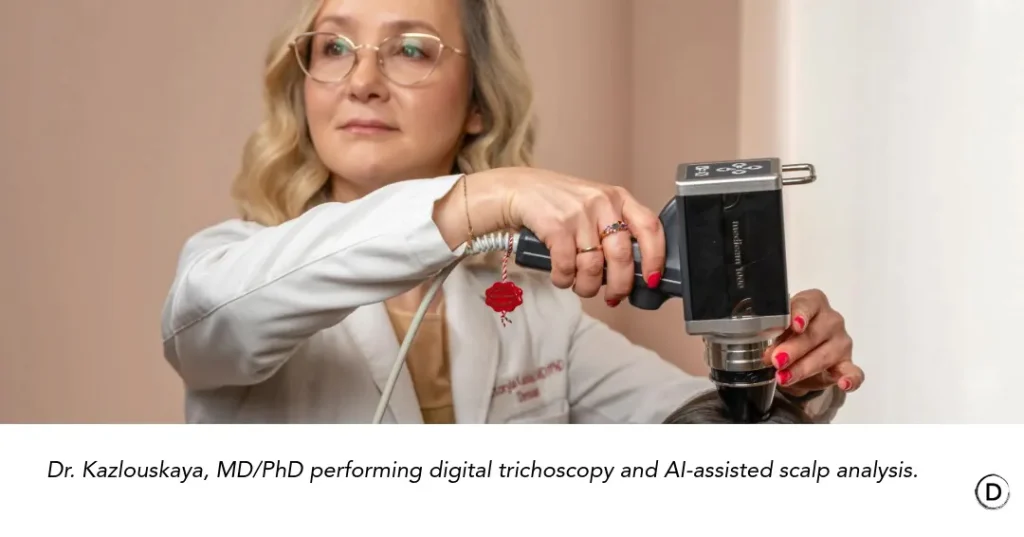
At Dermatology Circle, digital trichoscopy is incorporated into the hair loss consultation and can be used together with clinical examination and standardized imaging to document measurable changes over time.
A patient with heavy shedding but little evidence of miniaturization may have a different prognosis from someone with the same amount of shedding plus clear evidence of progressive follicular thinning.
Is a scalp biopsy necessary?
Usually not.
Straightforward telogen effluvium and classic pattern hair loss can often be diagnosed without biopsy.
A biopsy may be considered when the presentation is atypical, when inflammation or scarring is suspected, or when the diagnosis remains uncertain after examination and trichoscopy.
More information is available in Understanding Scalp Biopsies.
Treatment Options: When Observation Is Enough and When Treatment Makes Sense
Treatment should be based on the diagnosis rather than on the label “GLP-1 hair loss.”
Telogen effluvium
For uncomplicated telogen effluvium, treatment may primarily involve identifying and correcting the trigger.
Depending on the individual patient, this may include:
- ensuring adequate protein and calorie intake;
- correcting a documented deficiency;
- addressing thyroid or other medical abnormalities;
- allowing weight and nutritional intake to stabilize;
- reviewing other potential triggers.
In many cases, aggressive treatment is not necessary.
The hair cycle simply needs time to recover.
Pattern hair loss
If examination or trichoscopy shows follicular miniaturization, treatment for underlying androgenetic alopecia may be appropriate.
Depending on the patient, this may include minoxidil and other medical treatments selected according to the diagnosis, medical history, sex, reproductive considerations, and individual risk-benefit profile.
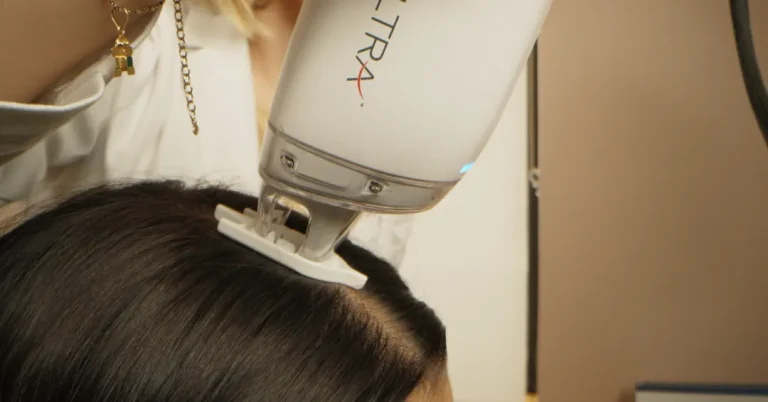
Adjunctive approaches such as low-level laser therapy for hair loss or selected procedural treatments may also be considered for appropriate patients.
These treatments should not be viewed as mandatory for every case of telogen effluvium.
Should You Stop a GLP-1 Medication Because of Hair Loss?
Do not stop or change a prescribed GLP-1 medication solely because of hair shedding without discussing it with the clinician who prescribed it.
The decision should take into account:
- why the medication was prescribed;
- its medical benefits;
- the severity of the hair loss;
- the speed of weight loss;
- nutritional status;
- whether telogen effluvium is actually present;
- whether another type of hair loss is occurring at the same time.
For many patients, GLP-1 treatment provides important metabolic benefits. Hair shedding alone does not necessarily mean the medication should be discontinued.
Medication decisions should be made together with the prescribing clinician.
When to See a Hair-Loss Expert Dermatologist
An evaluation is particularly useful if you notice:
- significant or persistent shedding;
- a progressively widening center part;
- visible reduction in hair density;
- recession of the hairline or temples;
- continued thinning after weight stabilizes;
- distinct patches of hair loss;
- scalp burning, itching, redness, or scaling;
- a personal or family history of pattern hair loss;
- uncertainty about whether the shedding is temporary.
Not every episode of hair loss during GLP-1 treatment is caused by weight loss. Autoimmune, inflammatory, and scarring forms of alopecia can occur independently.
The purpose of an evaluation is therefore not simply to confirm that hair is shedding. It is to determine whether the follicles are expected to recover normally or whether another process, such as miniaturization or inflammation, also needs treatment.
For an overview of diagnostic and treatment options, visit our Hair Loss and Hair Restoration center.
How We Diagnose and Treat GLP-1-Related Hair Loss at Dermatology Circle
Because GLP-1-related shedding can represent telogen effluvium, androgenetic alopecia, alopecia areata, or an overlap of more than one process, an accurate diagnosis is the foundation of any treatment plan.
At Dermatology Circle, every hair loss consultation begins with digital dermoscopy and AI-assisted scalp analysis, which allows us to objectively measure hair shaft diameter, follicular density, and the degree of miniaturization across different regions of the scalp. This lets us document, rather than estimate, whether a patient’s presentation is consistent with telogen effluvium alone, androgenetic alopecia, alopecia areata, or a combination, and to track measurable change over time as treatment progresses.
Once the diagnosis is clear, our approach to GLP-1-related shedding is built around a few principles:
- Nutritional support is foundational, not optional. Given how directly reduced intake can affect the hair cycle in this population, we routinely assess nutritional adequacy and, where appropriate, incorporate a physician-guided nutraceutical protocol such as Nutrafol to support the hair cycle during a period of significant dietary change.
- Combination therapy to help re-activate follicles. For patients where the hair cycle needs active support — rather than simply time — we frequently combine platelet-rich plasma (PRP) with Keralase (laser-assisted delivery to the follicle). Our clinical view is that this combination is particularly well suited to the GLP-1 population, where follicles may be dormant or under-stimulated during a period of significant metabolic change, rather than damaged outright.
- Targeted medical therapy when androgenetic alopecia is present. When trichoscopy shows miniaturization consistent with pattern hair loss, we discuss appropriate medical therapy, including finasteride or dutasteride for eligible patients as part of a longer-term plan, separate from whatever telogen effluvium component may also be present.
- A plan built around what we find, not the label “GLP-1 hair loss.” Because this presentation is genuinely heterogeneous, treatment is sequenced around the specific diagnosis and not applied as a single protocol to everyone who mentions Ozempic or Wegovy in their history.
The Bottom Line on GLP-1 Hair Loss
Hair shedding during treatment with Ozempic, Wegovy, Zepbound, Mounjaro, or after significant weight loss can have more than one explanation.
Rapid weight loss may trigger telogen effluvium. Reduced nutritional intake may contribute. At the same time, temporary shedding can reveal female or male pattern hair loss that had already been developing.
That overlap is important because the two conditions do not necessarily have the same prognosis or require the same treatment.
If there is no significant follicular miniaturization and the trigger resolves, time may be the most important part of recovery. If miniaturization, inflammation, or another type of alopecia is present, additional treatment may be appropriate.
Experiencing increased shedding or thinning after weight loss? A dermatologist-led hair loss consultation can help determine whether this is temporary shedding, pattern hair loss, or a combination of both.
Frequently Asked Questions About GLP-1 Hair Loss
Does Ozempic cause hair loss?
Hair loss has been reported in people using Ozempic, but this does not prove that the medication directly damages hair follicles. Rapid weight loss, reduced nutritional intake, telogen effluvium, and pre-existing pattern hair loss may all contribute.
Does Wegovy cause hair loss?
Hair loss has been reported during Wegovy treatment. In many patients, the association appears to be related to weight reduction rather than a clearly established direct toxic effect on the follicle.
If shedding occurs, the important question is whether it represents temporary telogen effluvium or another type of hair loss.
Can Zepbound or Mounjaro cause hair loss?
Hair loss has been reported during treatment with tirzepatide, the active medication in Zepbound and Mounjaro.
As with other GLP-1-based treatments, rapid weight loss, reduced food intake, telogen effluvium, and underlying androgenetic alopecia may all be relevant.
When does hair shedding usually start after weight loss?
When the process is telogen effluvium, noticeable shedding commonly begins about two to three months after the triggering physiological change.
Because weight loss may continue over many months, the exact timing can vary.
Will hair grow back after GLP-1-related shedding?
If the hair loss is uncomplicated telogen effluvium and the trigger resolves, regrowth is generally expected.
Visible density takes longer to recover because new hairs need time to grow. Recovery may be less complete if underlying pattern hair loss is present at the same time.
Should I take biotin or hair supplements?
Not automatically.
Hair shedding does not necessarily mean you have a vitamin deficiency. Laboratory testing or nutritional evaluation may be useful when the medical history suggests one.
Supplements are most appropriate when they address an identified need rather than being used as a substitute for diagnosis.
Could alopecia areata be involved instead of telogen effluvium?
It’s possible, though less common. Alopecia areata is an autoimmune condition that causes patchy, non-scarring hair loss and has been reported in patients on GLP-1 therapy. It looks and behaves differently from telogen effluvium or pattern hair loss, which is one reason a clinical evaluation with trichoscopy, rather than assuming the cause. It is important if shedding is patchy, sudden, or doesn’t fit a diffuse pattern.
Should I stop my GLP-1 medication if my hair is shedding?
Do not independently stop or change prescription treatment because of hair loss.
Discuss the situation with the clinician prescribing your GLP-1 medication. The benefits of treatment, rate of weight loss, nutritional status, and type of hair loss should all be considered.
When should I see a dermatologist?
Consider evaluation if shedding is severe or persistent, if your part is becoming wider, if density continues to decrease after your weight stabilizes, or if you develop patches of hair loss, scalp pain, burning, redness, or significant scaling.
At Dermatology Circle, Dr, Kazlouskaya, a hair loss expert dermatologist in NYC can use clinical examination and digital trichoscopy to determine whether the problem is temporary telogen effluvium, pattern hair loss, another type of alopecia, or a combination of several processes.