Spironolactone is one of the most useful systemic treatments for persistent acne in adult women. It can be particularly helpful when breakouts recur on the lower face or jawline, flare around the menstrual cycle, or return after repeated courses of oral antibiotics.
Current American Academy of Dermatology acne guidelines conditionally recommend spironolactone as a systemic acne therapy and emphasize limiting prolonged systemic antibiotic exposure when possible. At the same time, spironolactone remains an off-label treatment for acne in the United States. Its FDA-approved indications include cardiovascular and renal conditions, not acne.
Off-label does not mean experimental or inappropriate. It means the medication is being prescribed for a condition that is not listed among its FDA-approved indications. Dermatologists have extensive clinical experience using spironolactone for appropriately selected women with acne.
What Is Spironolactone?
Spironolactone was developed as an aldosterone antagonist and potassium-sparing diuretic. It is used medically for conditions including hypertension, heart failure, selected edema states, and disorders involving excess aldosterone.
The medication also has antiandrogen effects. In dermatology, those antiandrogen properties have made spironolactone useful for selected women with conditions influenced by androgen signaling, including acne and hirsutism.
Spironolactone is not itself a hormone. It modifies how androgen signaling affects responsive tissues.
How Does Spironolactone Help Acne?
Androgens, including testosterone and related hormones, can stimulate sebaceous glands. In an acne-prone follicle, androgen signaling may contribute to:
- Increased sebaceous activity;
- Increased sebum production;
- Follicular plugging;
- Inflammatory breakouts.
Spironolactone reduces androgen signaling at the receptor level. This can decrease one of the biological drivers of persistent acne in susceptible women.
Spironolactone does not “balance female hormones.” It reduces the effect of androgen signaling on androgen-sensitive tissues.
That distinction matters because terms such as “hormone balancing,” “estrogen dominance,” or “detoxing testosterone” do not accurately describe how the medication works.
Does “Hormonal Acne” Mean Your Hormones Are Abnormal?
No. This is one of the most common misunderstandings surrounding adult female acne. Most patients with acne do not automatically have abnormal serum androgen levels.
Routine endocrine testing is not indicated for most people with acne. Additional evaluation becomes more relevant when acne occurs with clinical signs of androgen excess, such as:
- Hirsutism;
- Irregular or absent menstrual periods;
- Androgen-pattern scalp hair loss;
- Infertility or features of polycystic ovary syndrome;
- Rapidly progressive symptoms or virilization.
Responding to spironolactone does not prove that a woman had elevated testosterone. Hair follicles and sebaceous glands can respond strongly to androgen signaling even when circulating hormone levels fall within the normal range.
What Does Androgen-Responsive Adult Acne Look Like?
Certain patterns may raise the likelihood that spironolactone could be useful. These include:
- Persistent acne beginning or continuing into adulthood;
- Inflammatory papules or deeper lesions;
- Recurrent chin, lower-face, or jawline involvement;
- Predictable menstrual flares;
- Acne that returns after oral antibiotics;
- Chest or back involvement in selected women.
AAD patient guidance notes that women with persistent lower-face, jawline, or neck acne may respond well to hormonal treatment. Distribution alone, however, is not diagnostic. Jawline acne can be a clue; it is not a laboratory test.
Who May Be a Good Candidate for Spironolactone?
Spironolactone may be particularly useful for adult women with persistent inflammatory acne, cyclical flares, recurrent lower-face acne, or disease that repeatedly returns after oral antibiotics. It can also be attractive when the goal is to avoid repeated or prolonged antibiotic treatment.
Candidacy depends on factors beyond the skin, including:
- Pregnancy plans;
- Kidney function;
- Blood pressure;
- Potassium risk;
- Current medications and supplements;
- Previous acne treatment;
- Acne severity and scarring risk.
A useful medication can still be the wrong treatment for a particular patient. A physician-directed acne evaluation should establish the diagnosis, assess scarring risk, and determine whether spironolactone fits the broader treatment plan.
How Effective Is Spironolactone for Adult Female Acne?
The evidence has strengthened considerably. The large SAFA phase 3 randomized controlled trial included more than 400 adult women with persistent facial acne considered significant enough to justify systemic antibiotic therapy.
Spironolactone produced better outcomes than placebo, with the difference becoming more apparent at 24 weeks than at 12 weeks. At week 24, 82% of participants receiving spironolactone reported improvement compared with 63% receiving placebo.
The practical message is: spironolactone works, but it should be evaluated over months rather than days.
Real Patient Case
Conquering Hormonal Acne: A Real Patient Result
This patient presented with severe hormonally influenced acne that had recurred after a previous course of isotretinoin. Rather than assuming that one medication would solve every part of the problem, treatment was built around a comprehensive regimen of targeted topical and oral medications.
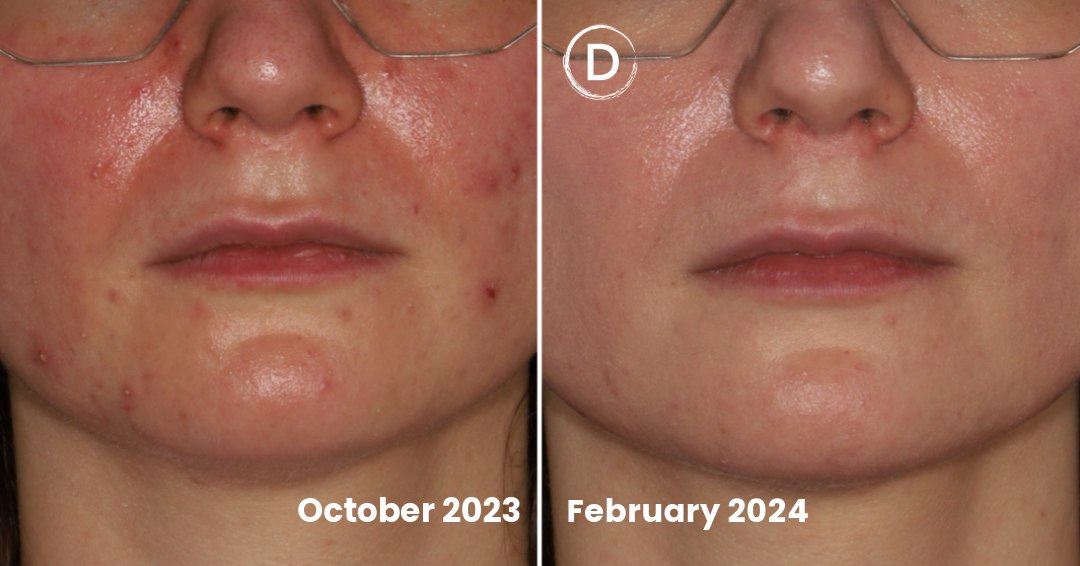
This case illustrates why adult female acne often requires a plan rather than a single prescription. The published case describes a combination of topical and oral treatment; it should not be interpreted as a spironolactone-only result or as a guarantee of the same outcome for another patient.
Does Acne Need to Get Worse Before It Gets Better?
No. Spironolactone does not have an expected initial “purge.” Breakouts may continue early in treatment because the medication has not yet reached its full clinical effect, existing lesions are still evolving, or topical treatment is being adjusted at the same time.
An early flare is not evidence that spironolactone is working. The concept of purging is more applicable to selected treatments that directly alter follicular turnover.
Spironolactone vs. Other Systemic Acne Treatments
| Feature | Spironolactone | Oral Antibiotics | Combined Oral Contraceptive | Isotretinoin |
|---|---|---|---|---|
| Primary role | Antiandrogen systemic treatment | Anti-inflammatory and antibacterial treatment | Hormonal acne treatment plus contraception | Broad sebaceous and follicular treatment |
| Adult female acne | Particularly useful in selected patients | Useful depending on severity | Useful when medically appropriate | Useful for severe, scarring, or refractory disease |
| Long-term treatment | Can be appropriate | Usually limited because of antibiotic stewardship | Can be long term when appropriate | Usually a defined treatment course |
| Pregnancy | Avoid | Depends on the antibiotic | Not used during pregnancy | Strictly contraindicated |
| Major advantage | Non-antibiotic systemic option | Can reduce inflammatory acne relatively quickly | Acne improvement plus contraception | Very high efficacy in appropriately selected severe disease |
| Important limitation | Potassium, blood pressure, and reproductive considerations | Resistance and prolonged-use concerns | Estrogen-related contraindications and risks | Pregnancy precautions and broader monitoring |
Spironolactone vs. Oral Antibiotics
This is one of the strongest reasons spironolactone has become more important in adult female acne management. Current acne guidelines emphasize limiting systemic antibiotic exposure when possible because of antibiotic resistance and other complications of prolonged use.
Spironolactone offers a non-antibiotic systemic option for appropriate women. That does not mean it always works faster than antibiotics. It means that chronic adult female acne can sometimes be controlled without cycling through repeated antibiotic courses.
Spironolactone vs. Birth Control Pills
Both treatments can improve androgen-responsive acne, but they work differently. Combined oral contraceptives can influence circulating androgen biology, improve acne, and provide contraception.
Some patients use both treatments. Others use spironolactone without a combined oral contraceptive. The important reproductive issue is that spironolactone should not be used during pregnancy.
Spironolactone vs. Isotretinoin
These medications often serve different clinical roles. Isotretinoin treatment becomes particularly important for acne that is:
- Severe;
- Nodular;
- Rapidly scarring;
- Refractory to appropriate conventional therapy.
AAD guidance strongly recommends isotretinoin for severe acne or disease causing scarring, substantial psychosocial burden, or failure of standard therapy.
Spironolactone can be particularly attractive for chronic adult female acne that repeatedly recurs and requires long-term suppression. Patients considering isotretinoin can also read Dermatology Circle’s guide to low-dose isotretinoin for adult acne.
Can Spironolactone Be Used With Topical Acne Treatments?
Yes. Systemic antiandrogen therapy and topical acne treatments target different parts of acne pathogenesis. Depending on the patient, a dermatologist may combine spironolactone with a topical retinoid, benzoyl peroxide, azelaic acid, clascoterone, or another topical medication.
AAD guidance favors combining therapies with different mechanisms when clinically appropriate. The regimen still needs to account for skin sensitivity, pregnancy plans, and which products the patient can use consistently.
What Are the Most Common Side Effects?
Potential side effects include:
- Increased urination;
- Menstrual irregularity;
- Breast tenderness or enlargement;
- Headache;
- Dizziness or lightheadedness;
- Fatigue.
In the SAFA trial, adverse reactions were slightly more common with spironolactone than placebo, particularly headache, but no serious adverse reactions were reported. Individual tolerance varies.
Can Spironolactone Lower Blood Pressure?
Yes. Spironolactone is also an antihypertensive medication. Some patients, particularly those whose blood pressure already runs low, may experience lightheadedness, dizziness, or orthostatic symptoms.
Does Spironolactone Cause Weight Gain?
Weight gain is not considered a defining or expected effect of spironolactone acne treatment. Because spironolactone is a diuretic, it can affect fluid balance, but that does not make it a weight-loss medication.
A substantial or unexplained weight change should be evaluated in clinical context rather than automatically attributed to spironolactone.
What About Potassium?
Spironolactone is potassium sparing. Hyperkalemia means an abnormally elevated blood potassium concentration. Risk becomes more relevant in patients with:
- Impaired kidney function;
- Pre-existing elevated potassium;
- Cardiovascular disease;
- Interacting medications;
- Potassium supplements or salt substitutes containing potassium;
- Older age or relevant medical comorbidities.
Does Every Healthy Woman Need Repeated Potassium Testing?
Not necessarily. A study of 974 healthy young women taking spironolactone for acne found a hyperkalemia rate of 0.72%, similar to the background rate of 0.76% in comparable women.
Current AAD guidance reflects this distinction: routine potassium monitoring is not considered necessary in healthy young patients, but testing should be considered when risk factors for hyperkalemia are present. The decision should be individualized rather than reduced to one rule for every patient.
Why Age Matters
This distinction becomes particularly important after the mid-40s. A 2026 retrospective cohort study examined women aged 45 and older receiving spironolactone for dermatologic conditions. Hyperkalemia occurred in 10.1% overall, with higher rates among older patients and those with relevant comorbidities. Most episodes were mild and asymptomatic, but the findings show why data from healthy women in their 20s should not be applied automatically to every age group.
An earlier acne-specific study also found a higher rate of incident hyperkalemia among women aged 46–65 than among women aged 18–45. This is particularly relevant when treating acne during perimenopause.
Can Spironolactone Affect Periods?
Yes. Possible changes include irregular bleeding, altered cycle timing, and breast tenderness.
Some women experience fewer menstrual side effects while using combined hormonal contraception, but an oral contraceptive has its own indications, contraindications, and risks. It should not be prescribed automatically simply to suppress a spironolactone side effect.
Spironolactone and Pregnancy
This should be addressed explicitly before treatment. Current U.S. prescribing information states that, based on its mechanism and animal reproductive data, spironolactone may affect male fetal sex differentiation.
Spironolactone should not be used during pregnancy. Patients who can become pregnant should discuss pregnancy plans and an appropriate prevention strategy with their clinician.
Does Spironolactone Increase Breast Cancer Risk?
This has been a longstanding patient concern. Current human evidence is reassuring. A 2024 retrospective cohort study of women receiving spironolactone for dermatologic conditions found no increased risk of breast or gynecologic malignancy.
Can Spironolactone Help Acne During Perimenopause?
Yes, in selected women. Adult acne may persist or recur during the menopausal transition, and spironolactone can remain useful when the acne pattern and medical history support its use.
Perimenopause is also a stage when blood pressure, kidney function, medications, menstrual changes, and potassium risk may be different from those of a healthy woman in her 20s. Treatment and monitoring should therefore be individualized.
How Long Can Someone Stay on Spironolactone?
Spironolactone can function as a long-term maintenance treatment when:
- It continues to control acne;
- It is tolerated;
- Pregnancy is avoided;
- Medical risk factors are periodically reassessed.
Unlike oral antibiotics, spironolactone does not create the same antimicrobial-resistance concern that pushes clinicians toward short courses. Long-term treatment should still include follow-up because medical history, medications, reproductive plans, and risk factors can change.
What Happens When You Stop Spironolactone?
Spironolactone controls an ongoing biological driver of acne. It does not permanently remove the underlying tendency toward androgen-responsive breakouts.
After discontinuation, some patients may remain relatively clear, while others may gradually develop recurrent acne. Recurrence does not mean the medication caused dependence. It means the biological tendency that spironolactone had been suppressing may still be present.
Can Spironolactone Treat Acne Scars?
No—not directly. Spironolactone can help control inflammatory acne and may therefore reduce the formation of additional scars. It does not remodel established depressed or raised scars.
Dermatology Circle’s acne scar treatment guide explains why scar type, depth, tethering, and skin tone should determine the procedure rather than treating every post-acne texture change with the same device.
What About Topical Spironolactone?
Topical spironolactone is receiving increasing research interest. A 2026 review comparing oral and topical spironolactone found that oral therapy has a substantially stronger evidence base, while topical formulations remain limited by small studies, heterogeneous formulations, and largely indirect evidence.
A recent review of topical hormonal treatments similarly concluded that topical spironolactone has potential but remains supported by limited data and is not FDA approved for acne. Formulations also vary substantially because topical spironolactone must be compounded.
Topical spironolactone is an emerging approach, not an established equivalent to oral spironolactone.
When Spironolactone Is Not Enough
Spironolactone may be only one component of treatment—or it may not be the right treatment at all. Alternatives or additions can include topical medication, a combined oral contraceptive, a limited course of an oral antibiotic, isotretinoin, or another diagnosis-specific approach.
The first priority is controlling active acne and reducing the risk of permanent scarring. Cosmetic treatment of residual redness, pigmentation, or scars can be planned once the inflammatory disease is controlled.
The Bottom Line
Spironolactone is an evidence-supported, non-antibiotic systemic option for selected women with persistent acne. It is most useful when chosen for the right patient, given enough time to work, and monitored according to age, medical history, medications, kidney function, blood pressure, potassium risk, and pregnancy plans.
“Hormonal acne” does not automatically mean abnormal hormone levels, and improvement with spironolactone does not prove that testosterone was elevated. Treatment should be based on the full clinical picture rather than the location of one breakout or a broad online checklist.
This article is for educational purposes and does not replace individualized medical evaluation, diagnosis, or treatment.